A Levels Biology (9700)•9700/12/M/J/18
A Levels Biology (9700) — 9700/12/M/J/18, Question 37
Why do people with HIV/AIDS have a higher occurrence of malaria than people without
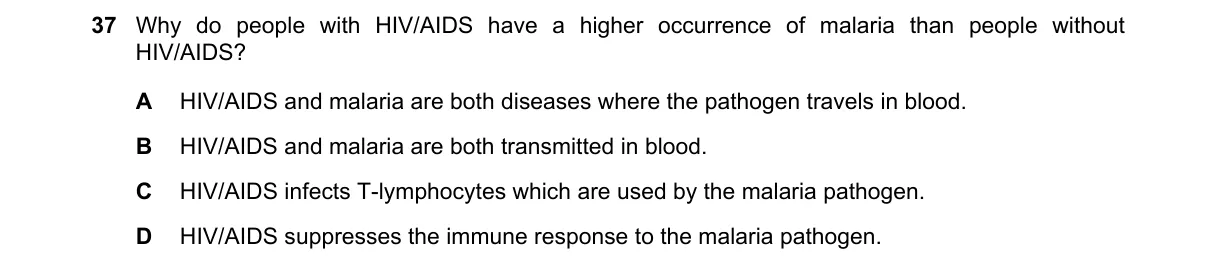
Answer choices
- AHIV/AIDS and malaria are both diseases where the pathogen travels in blood.
- BHIV/AIDS infects T-lymphocytes which are used by the malaria pathogen.
- COption C
- DHIV/AIDS suppresses the immune response to the malaria pathogen.
Explanation
Immune Suppression Increases Malaria Susceptibility
Steps:
- HIV/AIDS targets CD4+ T-cells, weakening overall immunity.
- Malaria, caused by Plasmodium parasites, relies on immune clearance for control.
- Compromised immunity allows higher parasite loads and frequent infections.
- This explains elevated malaria incidence in HIV-positive individuals.
Why D is correct:
- HIV/AIDS depletes CD4+ T-cells, suppressing adaptive immune responses that normally limit malaria parasitemia, per immunological definitions of immunosuppression.
Why the others are wrong:
- A: Blood transmission is coincidental but does not cause increased malaria occurrence.
- B: Malaria parasites infect red blood cells, not T-lymphocytes; HIV's effect is indirect via immunity loss.
- C: Not enough information (option blank).
Final answer: D
Topic: The immune system
Practice more A Levels Biology (9700) questions on mMCQ.me