A Levels Biology (9700)•9700/12/M/J/18
A Levels Biology (9700) — 9700/12/M/J/18, Question 33
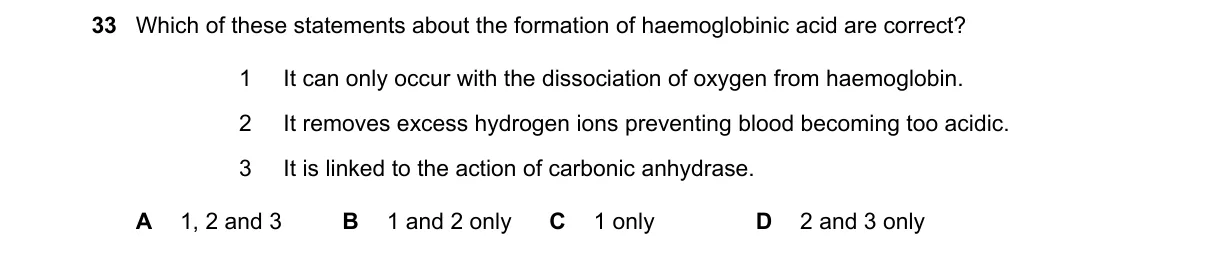
Which of these statements about the formation of haemoglobinic acid are correct?
1. It can occur with dissociation of oxygen from haemoglobin.
2. It removes excess hydrogen ions preventing blood becoming too acidic.
3. It is linked to the action of carbonic anhydrase.
Answer choices
- A1, 2 and 3
- B1 and 2 only
- C1 only
- D2 and 3 only
Explanation
Haemoglobinic Acid in Blood Buffering
Steps:
- Haemoglobinic acid (HHb) forms when deoxyhemoglobin binds H⁺ ions released from carbonic acid.
- Statement 1: Oxygen dissociation from HbO₂ produces deoxy-Hb, which readily accepts H⁺ to form HHb.
- Statement 2: HHb formation neutralizes excess H⁺ from CO₂ hydration, maintaining blood pH above 7.35.
- Statement 3: Carbonic anhydrase accelerates CO₂ + H₂O → H₂CO₃ → H⁺ + HCO₃⁻, supplying H⁺ for HHb.
Why A is correct:
- All statements align with the chloride shift and Haldane effect, where HHb buffers H⁺ during CO₂ transport (Hb + H⁺ ⇌ HHb).
Why the others are wrong:
- B omits carbonic anhydrase's essential role in H⁺ production.
- C ignores buffering and enzyme linkage.
- D excludes oxygen dissociation's facilitation of H⁺ binding.
Final answer: A
Topic: Transport of oxygen and carbon dioxide
Practice more A Levels Biology (9700) questions on mMCQ.me