A Levels Biology (9700)•9700/12/M/J/18
A Levels Biology (9700) — 9700/12/M/J/18, Question 30
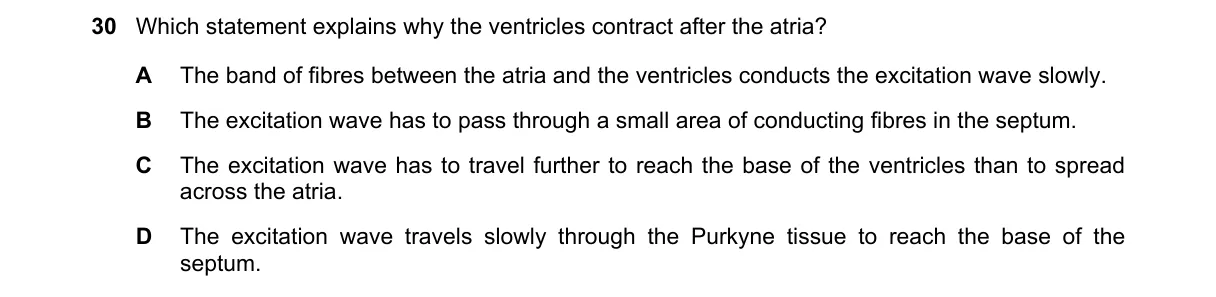
Which statement explains why the ventricles contract after atria
Answer choices
- AThe band of fibres between the atria and ventricles conducts the excitation wave slowly
- BThe excitation wave has to pass through a small area of conducting fibres in the septum.
- CThe excitation wave has to travel further to reach the base of the ventricles than to spread across the atria.
- DThe excitation wave travels slowly through the Purkyne tissue to reach the base of the septum.
Explanation
Cardiac conduction delay at AV node
Steps:
- Excitation begins at SA node and spreads rapidly across atria, causing atrial contraction.
- Impulse reaches AV node in interatrial septum, a narrow junction that slows conduction.
- Delay at AV node ensures atria empty blood into ventricles before ventricular contraction.
- Impulse then travels via AV bundle and Purkinje fibers to ventricles.
Why B is correct:
- AV node consists of small, specialized conducting fibers that inherently delay impulse transmission by 0.1 seconds, per cardiac physiology, allowing sequential contraction.
Why the others are wrong:
- A: AV bundle (not a "band of fibres") conducts quickly after AV node delay.
- C: Travel distance is not the primary factor; physiological delay at AV node is key.
- D: Purkinje tissue conducts rapidly, not slowly, to synchronize ventricular contraction.
Final answer: B
Topic: The heart
Practice more A Levels Biology (9700) questions on mMCQ.me