A Levels Biology (9700)•9700/12/M/J/18
A Levels Biology (9700) — 9700/12/M/J/18, Question 22
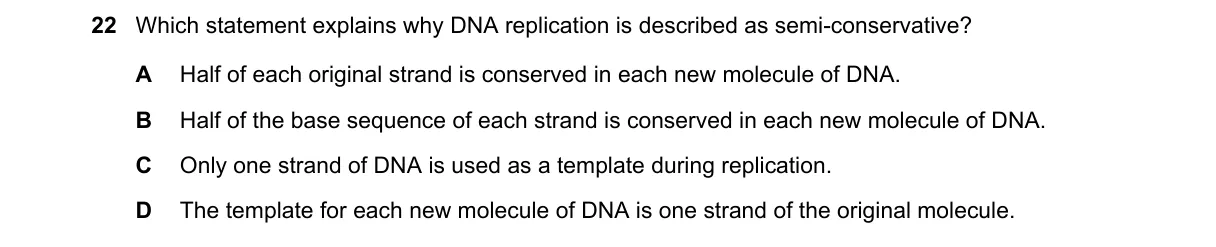
Which statement explains why DNA replication is described as semiconservative?
Answer choices
- AHalf of each original strand is conserved in each new molecule of DNA.
- BHalf of the base sequence of each strand is conserved in each new DNA.
- COnly one strand of DNA is used as a template during replication.
- DThe template for each new molecule of DNA is one strand of the original molecule.
Explanation
Semiconservative DNA replication conserves one original strand per new molecule
Steps:
- Recall that semiconservative replication, proven by Meselson-Stahl experiment, means each new DNA double helix has one parental strand and one newly synthesized strand.
- Evaluate choices against this: A and B misstate conservation as "half," C ignores both strands as templates, D matches the one original strand as template.
- Confirm D aligns with Watson-Crick model where each parental strand serves as a full template for a new complementary strand.
- Select D as it precisely explains the "semi" (half conserved) aspect.
Why D is correct:
- Semiconservative replication is defined as each new DNA molecule using one complete original strand as the template, conserving half the original duplex.
Why the others are wrong:
- A: Entire original strands are conserved, not just half of each.
- B: The full base sequence of each original strand is conserved, not half.
- C: Both strands of the original DNA serve as templates, not just one.
Final answer: D
Topic: Structure of nucleic acids and replication of DNA
Practice more A Levels Biology (9700) questions on mMCQ.me