A Levels Biology (9700)•9700/12/M/J/18
A Levels Biology (9700) — 9700/12/M/J/18, Question 18
One of the chromosomes in a nucleus has a telomere which contains many repeats of the base sequence TTAGGG. This chromosome was extracted from four different cells and the total number of bases in the telomere was determined. Which total number of bases found in the cell that had undergone the most mitotic divisions?
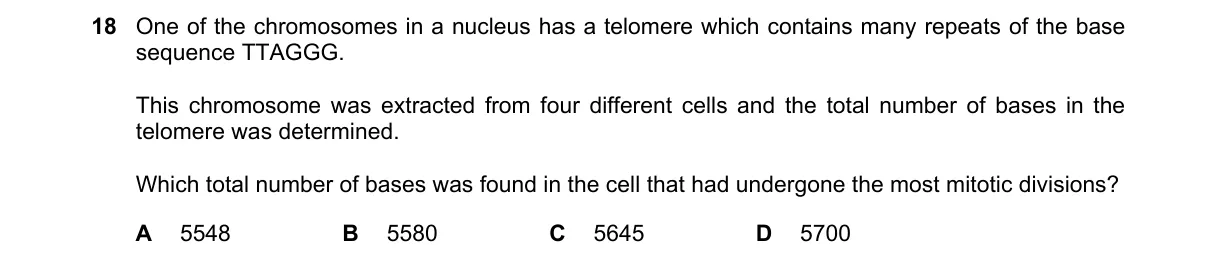
Answer choices
- A5548
- B5590
- C5645
- D5700
Explanation
Telomeres shorten with mitotic divisions
Steps:
- Telomere consists of TTAGGG repeats, each 6 bases long.
- During mitosis, telomeres shorten slightly due to the end-replication problem.
- More divisions result in greater shortening and fewer total bases.
- Smallest base count (5548) indicates most divisions.
Why A is correct:
- Shortest telomere (5548 bases) reflects maximum erosion from repeated divisions, per the end-replication mechanism.
Why the others are wrong:
- B (5590): Longer than A, so fewer divisions.
- C (5645): Even longer, indicating fewer divisions than A or B.
- D (5700): Longest, from the fewest divisions.
Final answer: A
Topic: Replication and division of nuclei and cells
Practice more A Levels Biology (9700) questions on mMCQ.me