A Levels Biology (9700)•9700/12/M/J/18
A Levels Biology (9700) — 9700/12/M/J/18, Question 15
The formula shows how the rate of diffusion across cell surface membrane can be calculated. Which row shows how the fastest rate of diffusion can be achieved?
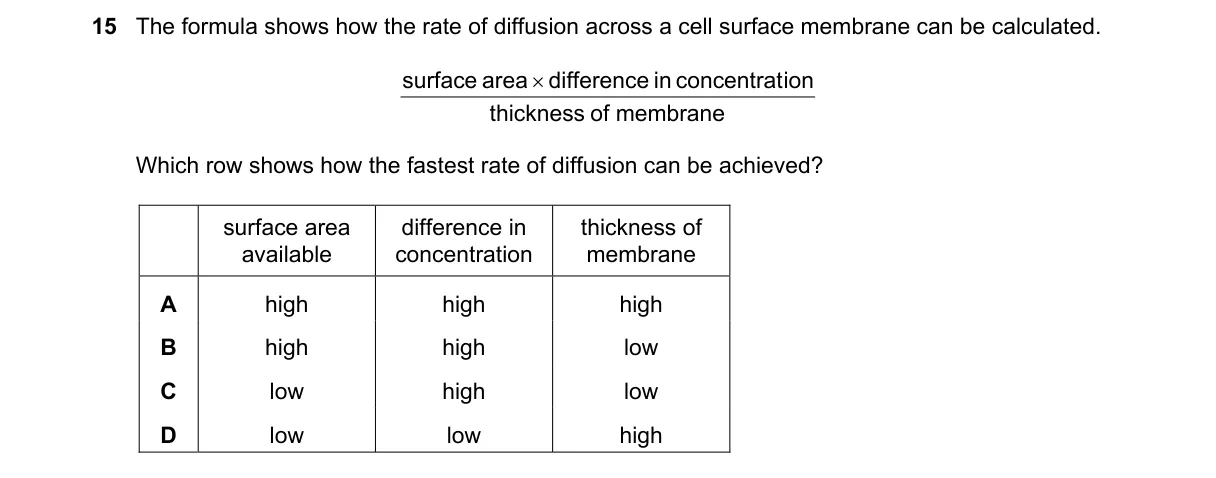
Answer choices
- Asurface area: high, difference in concentration: high, thickness of membrane: high
- Bsurface area: high, difference in concentration: low, thickness of membrane: high
- Csurface area: low, difference in concentration: high, thickness of membrane: low
- Dsurface area: low, difference in concentration: low, thickness of membrane: high
Explanation
Fick's Law of Diffusion Steps:
- Rate of diffusion = (surface area × concentration difference) / membrane thickness.
- Increase rate by maximizing surface area and concentration difference.
- Increase rate by minimizing membrane thickness.
- Compare options: A maximizes two factors (high area, high difference) despite high thickness; others have fewer favorable factors.
Why A is correct:
- High surface area and high concentration difference multiply to boost numerator in Fick's law, outweighing the high thickness denominator for fastest overall rate.
Why the others are wrong:
- B: Low concentration difference sharply reduces the rate despite high area.
- C: Low surface area limits the rate even with high difference and low thickness.
- D: All factors (low area, low difference, high thickness) minimize the rate.
Final answer: A
Topic: Movement into and out of cells
Practice more A Levels Biology (9700) questions on mMCQ.me