A Levels Biology (9700)•9700/12/M/J/18
A Levels Biology (9700) — 9700/12/M/J/18, Question 12
A student investigated the hydrolysis of lipid in high-fat milk using the enzyme lipase. 1 cm³ of enzyme solution was added to 10 cm³ of high-fat milk. The pH of the reaction was kept constant. recorded at 0 minutes and every minute for 20 minutes. Which statements could be supported by the results of the investigation? 1 less product could be made as time proceeds because the substrate is decreasing, 2 The pH of the reaction mixture changes more rapidly in the first minutes and 3 The pH changes less rapidly after the first minutes.
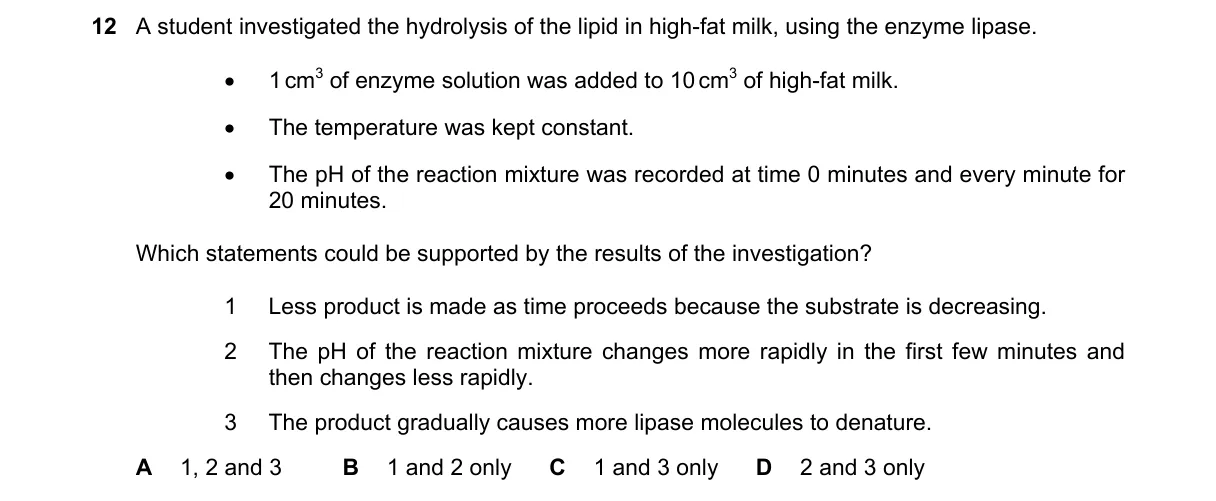
Answer choices
- A1, 2 and 3
- B1 and 2 only
- C1 and 3 only
- D2 and 3 only
Explanation
Enzyme kinetics in lipase hydrolysis
Steps:
- Lipase hydrolyzes lipids into fatty acids, which lower pH; rate is fastest initially with high substrate concentration.
- As reaction proceeds, substrate decreases, slowing the rate and reducing product formation per unit time (statement 1).
- Initial high rate causes rapid pH drop in early minutes (statement 2).
- Later, slower rate leads to less rapid pH change (statement 3).
- Constant pH implies buffering, but recorded changes reflect acid production rate, supporting all statements.
Why A is correct:
- Michaelis-Menten kinetics predicts initial rapid reaction followed by deceleration as substrate depletes, aligning with all three observations.
Why the others are wrong:
- B omits statement 3, but slowing after initial phase is expected.
- C omits statement 2, but rapid early pH change occurs due to high initial rate.
- D omits statement 1, but decreasing substrate limits product formation over time.
Final answer: A
Topic: Mode of action of enzymes
Practice more A Levels Biology (9700) questions on mMCQ.me