A Levels Biology (9700)•9700/11/M/J/18
A Levels Biology (9700) — 9700/11/M/J/18, Question 40
The statements describe ways in which different types of monoclonal antibodies work. 1 binding to proteins on cell surfaces and triggering the immune system. 2 blocking molecules on cell surfaces that inhibit T-cells. 3 blocking cell signaling receptors that trigger cell division. 4 blocking cell signaling receptors that trigger immune response. Which type of monoclonal antibody could be used to treat cancer?
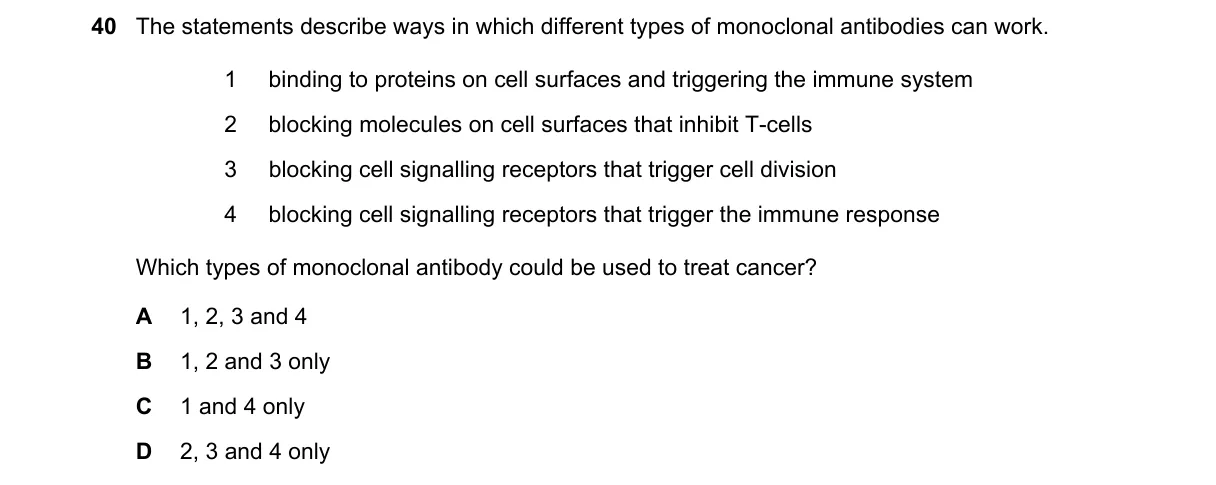
Answer choices
- A1, 2 and 4 only
- B1, 2 and 3 only
- C1, 3 and 4 only
- D2 and 4 only
Explanation
Monoclonal Antibodies Targeting Cancer Mechanisms
Steps:
- Cancer monoclonal antibodies work by marking tumor cells for immune destruction, enhancing T-cell activity against tumors, or inhibiting cancer cell growth signals.
- Evaluate statement 1: Binding to cell surface proteins flags cancer cells, triggering immune attack—effective for cancer.
- Evaluate statement 2: Blocking inhibitory molecules on cells activates T-cells to target tumors—key in immunotherapy.
- Evaluate statement 3: Blocking receptors that promote cell division halts cancer proliferation—directly anti-cancer.
- Evaluate statement 4: Blocking immune response receptors suppresses anti-tumor immunity—harmful for cancer treatment.
Why B is correct:
- B selects 1, 2, and 3, matching cancer mAb strategies like rituximab (1), PD-1 inhibitors (2), and trastuzumab (3) that attack tumors without suppressing immunity.
Why the others are wrong:
- A includes 4, which blocks immune responses and weakens anti-cancer effects.
- C includes 4 (immunosuppressive) and excludes 2 (essential T-cell activation).
- D omits 1 and 3 (tumor targeting and growth inhibition) while including harmful 4.
Final answer: B
Topic: Antibodies and vaccination
Practice more A Levels Biology (9700) questions on mMCQ.me