A Levels Biology (9700)•9700/11/M/J/18
A Levels Biology (9700) — 9700/11/M/J/18, Question 37
Some animals have genes that code for small peptides called cathelicidins. These peptides kill a wide range of bacteria by attaching to lipids in bacterial cell membranes, so weakening or disrupting them. Scientists have produced a synthetic version of the cathelicidin that kills bacteria that are resistant to tetracycline. Which pair of statements explains how this synthetic cathelicidin might help with the problem of antibiotic resistance? 1 It is synthetic so bacteria can never become resistant to it. 2 It could be used instead of tetracycline, allowing tetracycline resistance to be reduced. 3 The only way bacteria develop resistance to it is by altering the lipids in their membranes. 4 It could be used to kill multidrug-resistant strains of bacteria for which there is no effective antibiotic.
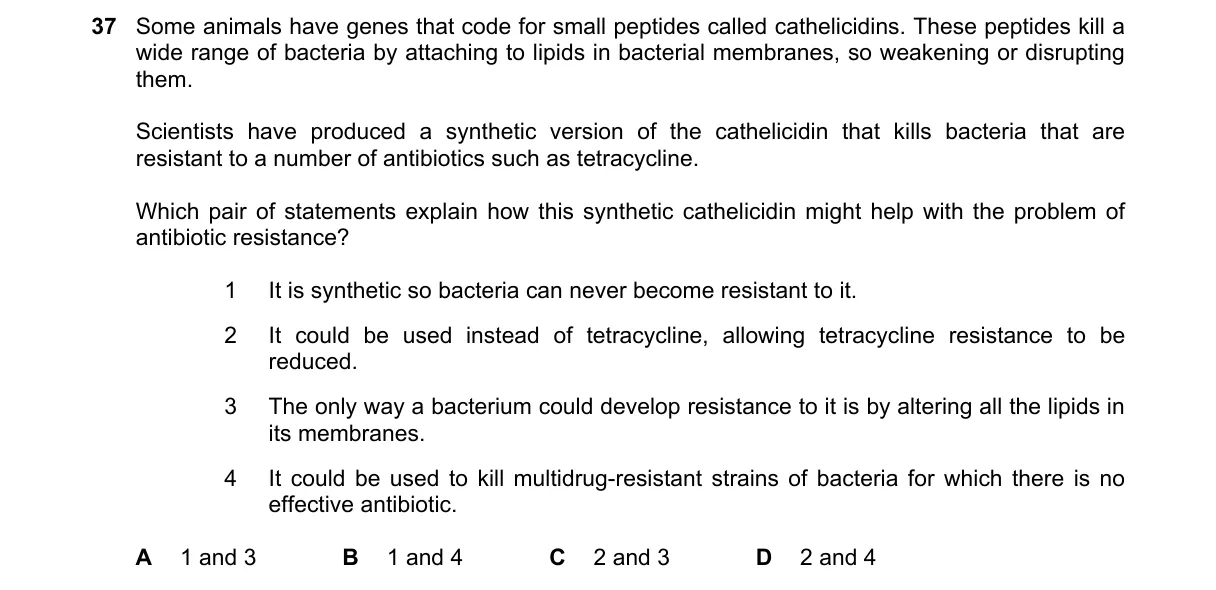
Answer choices
- A1 and 3
- B1 and 4
- C2 and 3
- D2 and 4
Explanation
Synthetic cathelicidin offers new antibacterial options against resistance
Steps:
- Statement 1 is incorrect because synthetic compounds can still face bacterial resistance through evolution.
- Statement 2 is correct as substituting cathelicidin for tetracycline reduces selective pressure, allowing sensitive bacteria to outcompete resistant ones.
- Statement 3 is inaccurate since bacteria could resist via other mechanisms like efflux pumps, not just lipid changes.
- Statement 4 is correct because cathelicidin targets resistant strains lacking effective treatments.
Why D is correct:
- It pairs mechanisms reducing resistance spread (via substitution) with direct treatment of resistant bacteria, per evolutionary principles of antibiotic stewardship.
Why the others are wrong:
- A: Includes false claim in 1 that bacteria cannot resist synthetics.
- B: Relies on invalid 1, ignoring resistance potential.
- C: Features misleading 3 limiting resistance pathways unrealistically.
Final answer: D
Topic: Antibiotics
Practice more A Levels Biology (9700) questions on mMCQ.me