A Levels Biology (9700)•9700/11/M/J/18
A Levels Biology (9700) — 9700/11/M/J/18, Question 13
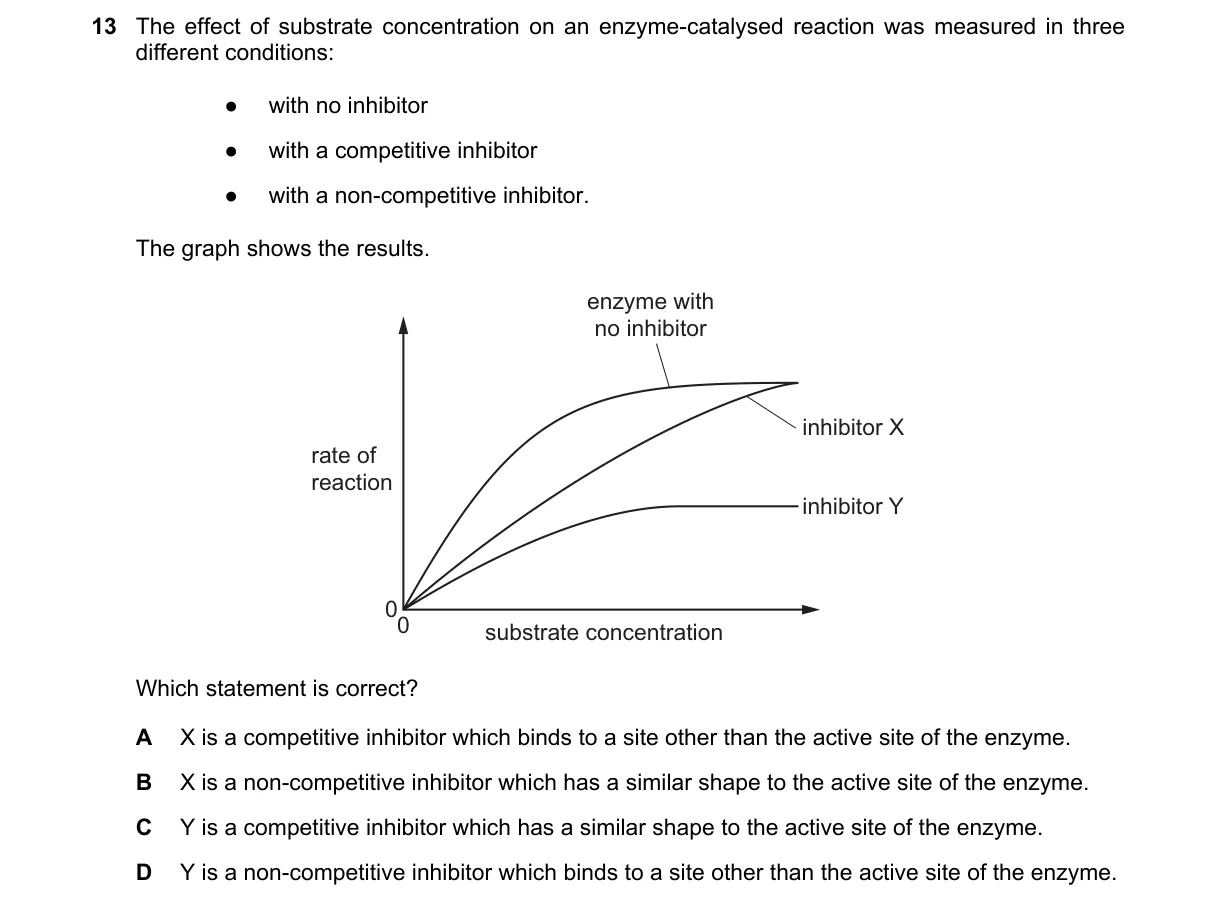
The effect of substrate concentration on an enzyme-catalysed reaction was measured in three conditions: • with no inhibitor • with a competitive inhibitor • with a non-competitive inhibitor. The graph shows the results. Which statement is correct?
Answer choices
- AX is a competitive inhibitor which binds to a site other than the active site of the enzyme.
- BY is a competitive inhibitor which has a similar shape to the active site of the enzyme.
- CY is a non-competitive inhibitor which binds to a site other than the active site of the enzyme.
- DX is a non-competitive inhibitor which binds to a site other than the active site of the enzyme.
Explanation
Distinguishing enzyme inhibitors by effects on Km and Vmax
Steps:
- Competitive inhibitors increase Km (apparent lower substrate affinity) but Vmax unchanged, as they compete for the active site.
- Non-competitive inhibitors decrease Vmax (reduced maximum rate) but Km unchanged, as they bind elsewhere and alter enzyme function.
- Graph line X shows same Km (x-intercept) but lower Vmax (y-intercept), indicating non-competitive inhibition.
- Non-competitive inhibitors bind to an allosteric site, not the active site, confirming X's identity.
Why D is correct:
- Non-competitive inhibition decreases Vmax without affecting Km, and these inhibitors bind to a site other than the active site by definition.
Why the others are wrong:
- A: X shows unchanged Km and decreased Vmax, characteristic of non-competitive, not competitive inhibition.
- B: Y shows increased Km and unchanged Vmax, indicating competitive inhibition that mimics substrate shape for active site binding.
- C: Y exhibits competitive inhibition traits (increased Km, same Vmax), not non-competitive.
Final answer: D
Topic: Factors that affect enzyme action
Practice more A Levels Biology (9700) questions on mMCQ.me