O Levels/IGCSE Accounting (7707)•7707/12/O/N/23
O Levels/IGCSE Accounting (7707) — 7707/12/O/N/23, Question 1
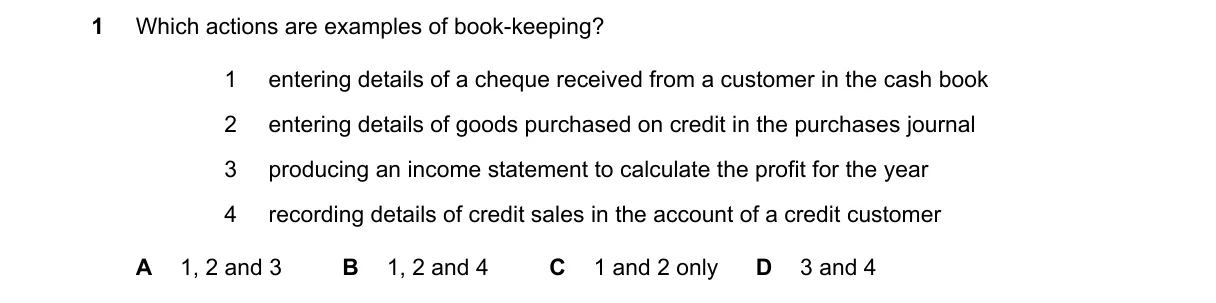
Which actions are examples of book-keeping? 1 entering details of a cheque received from a customer in the cash book 2 entering details of goods purchased on credit in the purchases journal 3 producing an income statement to calculate the profit for the year 4 recording details of credit sales in the account of a customer
Answer choices
- A1,2 and 3
- B1,2 and 4
- C1 and 2 only
- D3 and 4
Explanation
Book-keeping records daily financial transactions
Steps:
- Define book-keeping as the process of systematically recording business transactions in journals and ledgers.
- Evaluate option 1: Entering cheque details in the cash book is a recording of cash inflow, so it's book-keeping.
- Evaluate option 2: Entering credit purchases in the purchases journal records a liability, so it's book-keeping.
- Evaluate option 3: Producing an income statement summarizes data to calculate profit, which is accounting analysis, not basic recording.
- Evaluate option 4: Recording credit sales in a customer's account updates the ledger, so it's book-keeping.
Why B is correct:
- B selects 1, 2, and 4, matching the definition of book-keeping as transaction recording in books of original entry or ledgers.
Why the others are wrong:
- A includes 3, which is financial reporting, not recording.
- C omits 4, a valid ledger entry.
- D includes 3 and omits recording actions 1, 2, and 4.
Final answer: B
Topic: The double entry system of book-keeping
Practice more O Levels/IGCSE Accounting (7707) questions on mMCQ.me