O Levels/IGCSE Accounting (7707)•7707/12/O/N/20
O Levels/IGCSE Accounting (7707) — 7707/12/O/N/20, Question 2
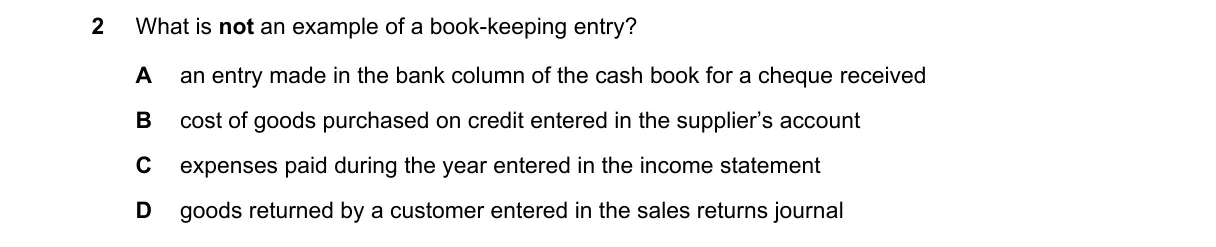
What is not an example of a book-keeping entry?
Answer choices
- Aan entry made in the bank column of the cash book for cheque received
- Bcost of goods purchased on credit entered in the supplier's account
- Cexpenses paid during the year entered in the income statement
- Dgoods returned by a customer entered in the sales returns journal
Explanation
Book-keeping entries record transactions in journals and ledgers, not financial statements.
Steps:
- Define book-keeping entry as a record of transactions in accounting books like journals, ledgers, or cash books.
- Evaluate option A: It's a direct entry in the cash book, a book-keeping record.
- Evaluate option B: It's a ledger entry in the supplier's account, part of book-keeping.
- Evaluate option C: Entering expenses in the income statement is part of financial reporting, not initial book-keeping.
- Evaluate option D: It's a journal entry in the sales returns book, a book-keeping record.
Why C is correct:
- Book-keeping involves recording raw transactions in journals and ledgers; the income statement is a summarized financial statement prepared after book-keeping, per double-entry accounting principles.
Why the others are wrong:
- A: Cash book entries are fundamental book-keeping for tracking receipts.
- B: Supplier account entries are ledger postings, core to book-keeping.
- D: Sales returns journal records returns as part of transactional book-keeping.
Final answer: C
Topic: The double entry system of book-keeping
Practice more O Levels/IGCSE Accounting (7707) questions on mMCQ.me