O Levels/IGCSE Accounting (7707)•7707/12/M/J/25
O Levels/IGCSE Accounting (7707) — 7707/12/M/J/25, Question 2
How is owner's equity calculated?
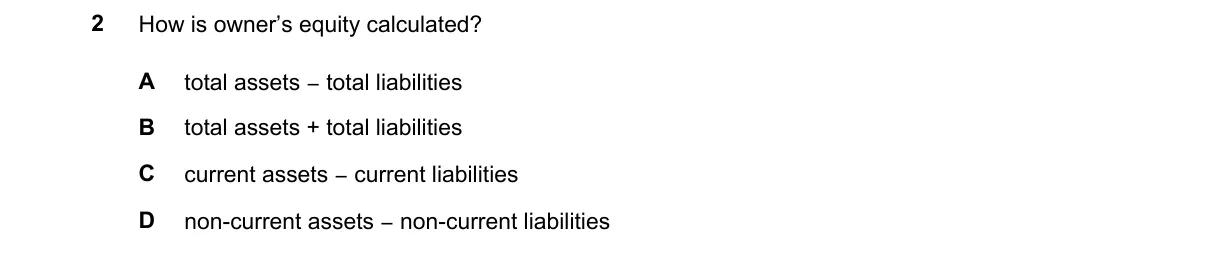
Answer choices
- Atotal assets - total liabilities
- Bcurrent assets - current liabilities
- Ctotal assets - current liabilities
- Dnon-current assets - non-current liabilities
Explanation
Owner's Equity from the Accounting Equation
Steps:
- Recall the fundamental accounting equation: Assets = Liabilities + Owner's Equity.
- Rearrange the equation to isolate Owner's Equity: Owner's Equity = Assets - Liabilities.
- Identify that total assets and total liabilities represent the full balance sheet scope.
- Confirm this calculation determines the owner's residual interest in the business.
Why A is correct:
- It directly follows the accounting equation, where owner's equity equals total assets minus total liabilities, representing the net worth owned by the proprietor.
Why the others are wrong:
- B calculates working capital, not owner's equity.
- C ignores non-current liabilities, understating equity.
- D only considers long-term items, omitting current assets and liabilities.
Final answer: A
Topic: The accounting equation
Practice more O Levels/IGCSE Accounting (7707) questions on mMCQ.me