O Levels/IGCSE Accounting (7707)•7707/12/M/J/22
O Levels/IGCSE Accounting (7707) — 7707/12/M/J/22, Question 12
Which statement about the reducing balance method of depreciation is not correct?
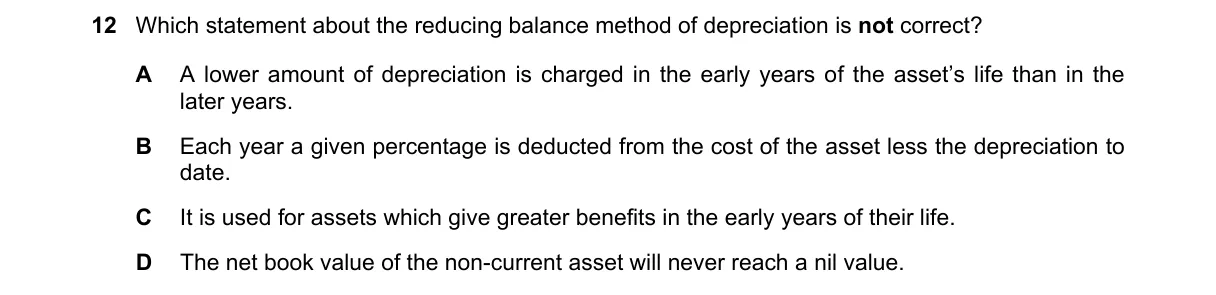
Answer choices
- AA lower amount of depreciation is charged in the early years of the asset's life.
- BEach year a given percentage is deducted from the cost of the asset less depreciation to date.
- CIt is used for assets which give greater benefits in the early years of their life.
- DThe net book value of the non-current asset will never reach nil value.
Explanation
Reducing Balance Depreciation Misconception
Steps:
- Recall reducing balance method applies fixed percentage to net book value each year, leading to higher initial depreciation.
- Evaluate option A: It claims lower depreciation early, which contradicts the method's accelerating nature.
- Check B: Confirms percentage on reducing balance, matching the formula.
- Verify C: Aligns with use for assets like computers that yield more early benefits.
- Assess D: Notes book value approaches zero asymptotically but never reaches nil.
Why A is correct:
- Reducing balance charges higher depreciation in early years via formula: Depreciation = Net book value × Fixed rate, decreasing over time.
Why the others are wrong:
- B accurately describes the core calculation of applying percentage to diminishing balance.
- C correctly identifies suitability for assets with front-loaded benefits, unlike straight-line.
- D is true as depreciation never fully eliminates residual value mathematically.
Final answer: A
Topic: Accounting for depreciation and disposal of non-current assets
Practice more O Levels/IGCSE Accounting (7707) questions on mMCQ.me