O Levels/IGCSE Accounting (7707)•7707/12/M/J/20
O Levels/IGCSE Accounting (7707) — 7707/12/M/J/20, Question 31
The following ratios have been calculated for a trader. profit margin year 1 15% year 2 20% return on capital employed (ROCE) 9% 6% What explains these changes?
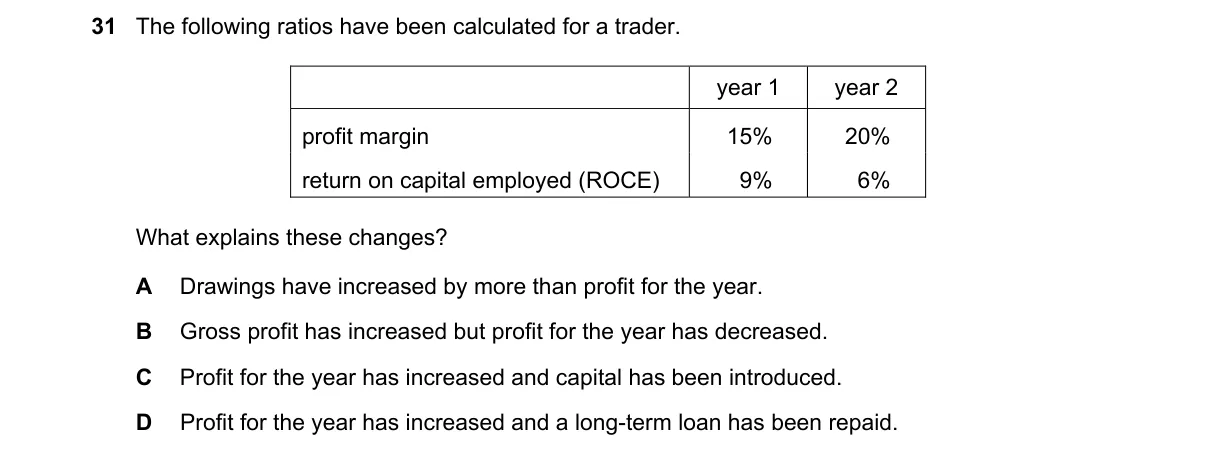
Answer choices
- ADrawings have increased more than profit for the year.
- BGross profit has increased but for the year has decreased.
- CGross profit has increased and capital has been introduced.
- DProfit for the year has increased and a long-term loan has been repaid.
Explanation
Profit margin rose while ROCE fell due to capital growth outpacing profit gains
Steps:
- Profit margin (net profit/sales) increased from 15% to 20%, indicating higher profitability relative to sales, likely from rising gross profit.
- ROCE (profit/capital employed) decreased from 9% to 6%, showing lower returns despite profit gains, implying capital employed grew faster than profit.
- Capital introduction boosts capital employed denominator, diluting ROCE.
- Gross profit rise supports the profit margin improvement without contradicting ROCE decline.
Why C is correct:
- ROCE formula (profit/capital employed) decreases when capital introduced increases the denominator more than profit rises; gross profit increase drives the higher profit margin (net profit/sales).
Why the others are wrong:
- A: Drawings reduce capital employed, raising ROCE, opposite of the observed decline.
- B: Net profit decrease would lower profit margin, not raise it from 15% to 20%.
- D: Repaying long-term loan reduces capital employed, increasing ROCE, not decreasing it.
Final answer: C
Topic: Interpretation of accounting ratios
Practice more O Levels/IGCSE Accounting (7707) questions on mMCQ.me