O Levels/IGCSE Accounting (7707)•7707/11/M/J/20
O Levels/IGCSE Accounting (7707) — 7707/11/M/J/20, Question 31
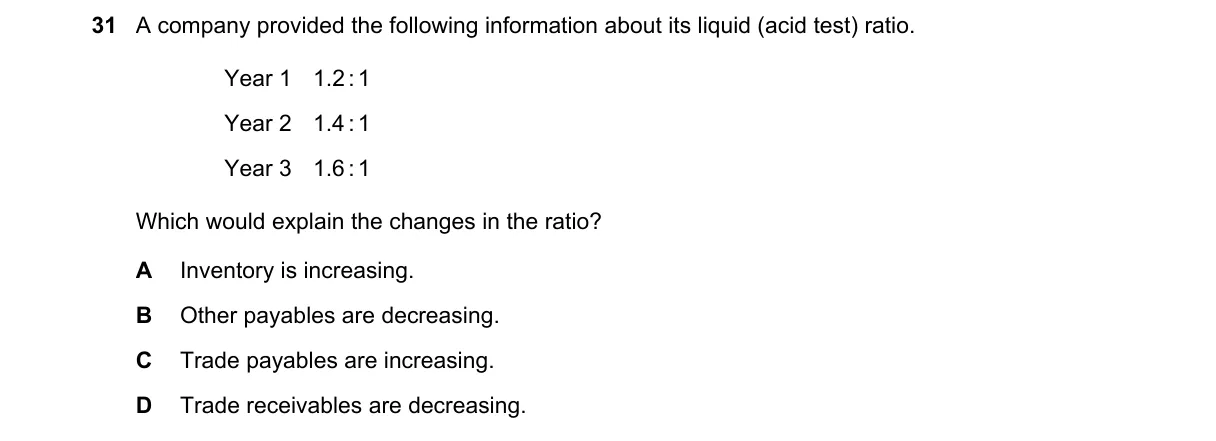
A company provided the following information about its liquid (acid test) ratio. Year 1 1:2 Year 2 1:1 Year 3 1:6 Which changes would explain the changes in the ratio?
Answer choices
- AInventory is increasing.
- BOther payables are decreasing.
- CTrade payables are increasing.
- DTrade receivables are decreasing.
Explanation
Acid-test ratio fluctuations due to liability changes
Steps:
- Recall acid-test (quick) ratio formula: (Current assets - Inventory) / Current liabilities.
- Note ratio progression: Year 1 (1:2 or 0.5), improves to Year 2 (1:1 or 1.0), then declines to Year 3 (1:6 or ~0.17).
- Identify that improvement from Year 1 to 2 requires numerator increase or denominator decrease; decline to Year 3 requires opposite.
- Evaluate options: Focus on changes affecting quick assets (numerator) or current liabilities (denominator) to match pattern.
Why B is correct:
- Decreasing other payables reduces current liabilities (denominator), increasing the ratio from Year 1 to 2; if decrease reverses or other factors dominate in Year 3, it explains the decline.
Why the others are wrong:
- A: Inventory increase does not affect quick ratio, as inventory is excluded from numerator.
- C: Trade payables increase raises liabilities, consistently decreasing ratio, not matching Year 1-2 improvement.
- D: Trade receivables decrease lowers quick assets (numerator), consistently decreasing ratio, not explaining improvement.
Final answer: B
Topic: Interpretation of accounting ratios
Practice more O Levels/IGCSE Accounting (7707) questions on mMCQ.me