O Levels/IGCSE Biology (5090)•5090/12/O/N/24
O Levels/IGCSE Biology (5090) — 5090/12/O/N/24, Question 23
As a result of an accident in a factory, a small piece of metal entered the spinal cord of an engineer and severed the tissue at X. The diagram shows section through the spinal cord in the neck at the point of injury. A nervous pathway is also shown. Which outcome from the accident is possible?
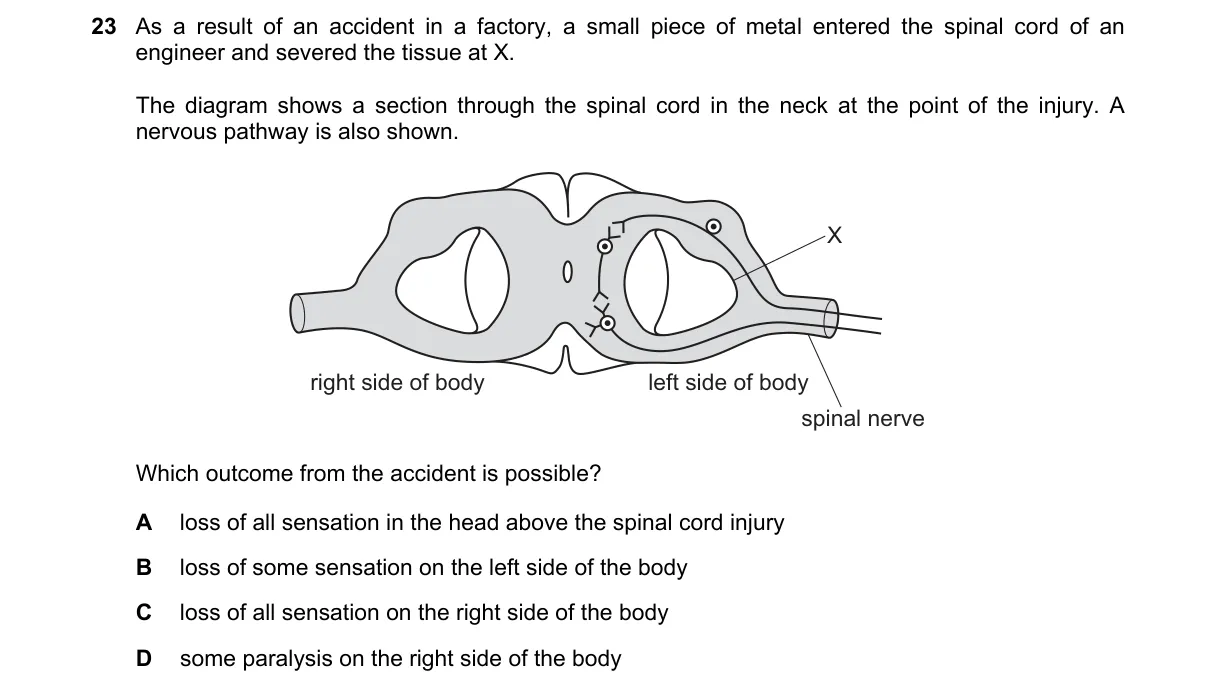
Answer choices
- Aloss of sensation on the left side of the body
- Bloss of sensation on the right side of the body
- Csome paralysis on the right side of the body
- Dloss of all sensation on the left side of the body
Explanation
Spinal Cord Decussation and Contralateral Sensory Pathways
Steps:
- Identify injury location: Severing at X in cervical spinal cord disrupts ascending sensory tracts.
- Recall sensory pathway: Spinothalamic tract for pain/temperature decussates shortly after entering cord, carrying signals contralaterally.
- Determine affected side: If X is on left, it severs right-body sensory fibers crossing from right.
- Predict outcome: Results in contralateral (right-side) sensory loss below injury.
Why B is correct:
- Spinothalamic tract decussation in spinal cord means left-side injury blocks right-body sensation signals, per neuroanatomy principles.
Why the others are wrong:
- A: Sensory loss is contralateral, not ipsilateral to left injury.
- C: Motor (corticospinal) effects are ipsilateral; paralysis occurs on left, not right.
- D: Specifies "all" sensation, but dorsal columns (proprioception) ascend ipsilaterally before decussating in medulla, so not fully affected contralaterally.
Final answer: B
Topic: Mammalian nervous system
Practice more O Levels/IGCSE Biology (5090) questions on mMCQ.me