O Levels/IGCSE Biology (5090)•5090/11/O/N/24
O Levels/IGCSE Biology (5090) — 5090/11/O/N/24, Question 38
What can the students conclude from these results?
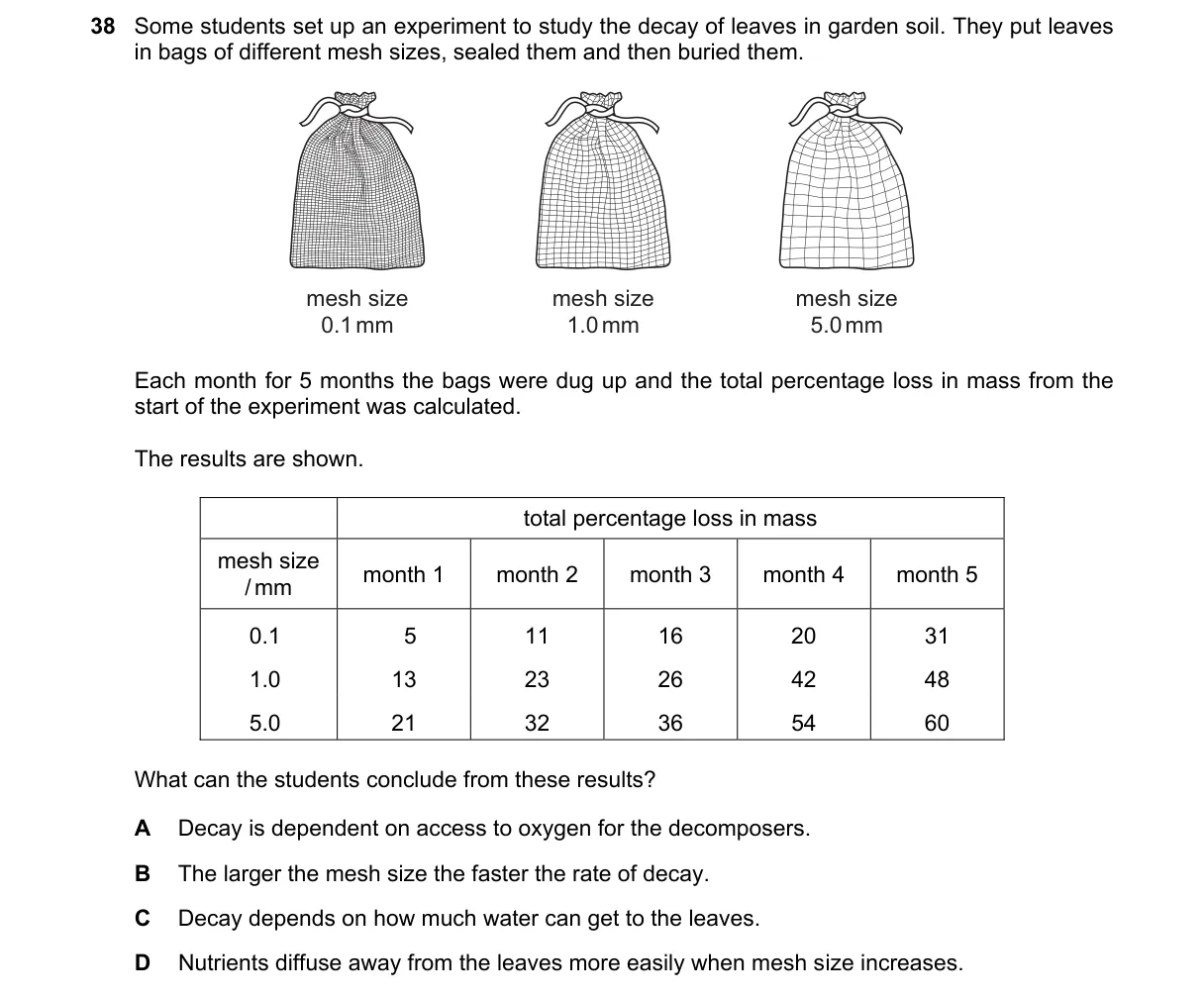
Answer choices
- AThe larger the mesh size on the faster the rate of the decompos.
- BDecay depends on how much water can get to the leaves.
- CDecay depends on how much water can get to the leaves.
- DNutrients diffuse away from the leaves more easily when mesh increases.
Explanation
Water access drives leaf decay rate
Steps:
- Observe decay rates across mesh sizes from experimental results.
- Note faster decomposition with larger mesh, indicating increased factor penetration.
- Identify water as the key variable, as mesh affects moisture entry to leaves.
- Conclude decay relies on water availability, not other factors like direct nutrient loss.
Why B is correct:
- Decomposition requires moisture for microbial activity; larger mesh allows more water ingress, accelerating breakdown per ecological principles of wet decomposition.
Why the others are wrong:
- A: Incomplete and grammatically flawed; results link mesh to water, not directly to speed without mechanism.
- C: Identical to B, but listed separately—likely a duplication error, not a distinct conclusion.
- D: Focuses on nutrient diffusion, but results emphasize water's role in enabling decay processes, not nutrient escape.
Final answer: B
Topic: Nutrient cycles
Practice more O Levels/IGCSE Biology (5090) questions on mMCQ.me