O Levels/IGCSE Biology (5090)•5090/11/O/N/24
O Levels/IGCSE Biology (5090) — 5090/11/O/N/24, Question 3
The bacterium Vibrio cholerae that causes disease cholera acts on the cells of the intestinal wall. It causes chloride ions to move out of the cells into the small intestine. Which process will lead to the production of dangerously high amounts of water diarrhoea?
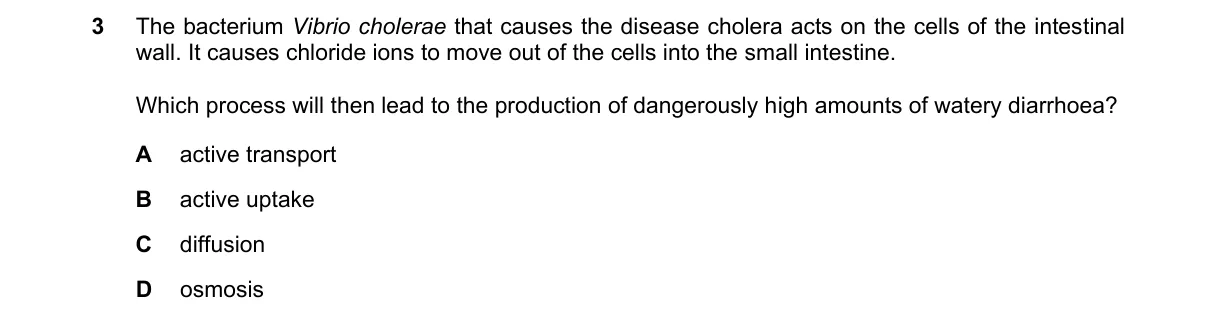
Answer choices
- Aactive transport
- Bactive uptake
- Cdiffusion
- Dosmosis
Explanation
Chloride efflux drives osmotic water loss
Steps:
- Chloride ions exit intestinal cells into the lumen via bacterial toxin effects.
- This increases solute concentration in the intestinal fluid.
- Water moves from cells and blood into the hypertonic intestine to balance osmolarity.
- Excessive water secretion causes severe diarrhea.
Why D is correct:
- Osmosis is the passive movement of water across a semi-permeable membrane from low to high solute concentration, as defined by osmotic pressure gradients.
Why the others are wrong:
- A. Active transport uses energy to move ions against gradients; water loss here is passive.
- B. Active uptake involves energy-dependent absorption into cells; opposite of secretion.
- C. Diffusion applies to solutes like chloride but not specifically to water's bulk movement.
Final answer: D
Topic: Diffusion and osmosis
Practice more O Levels/IGCSE Biology (5090) questions on mMCQ.me