O Levels/IGCSE Biology (5090)•5090/12/O/N/22
O Levels/IGCSE Biology (5090) — 5090/12/O/N/22, Question 5
Fats are broken down by the enzyme lipase to produce fatty acids and glycerol. According to the lock and key model of enzyme action, what is the lock and what is the key in this reaction?
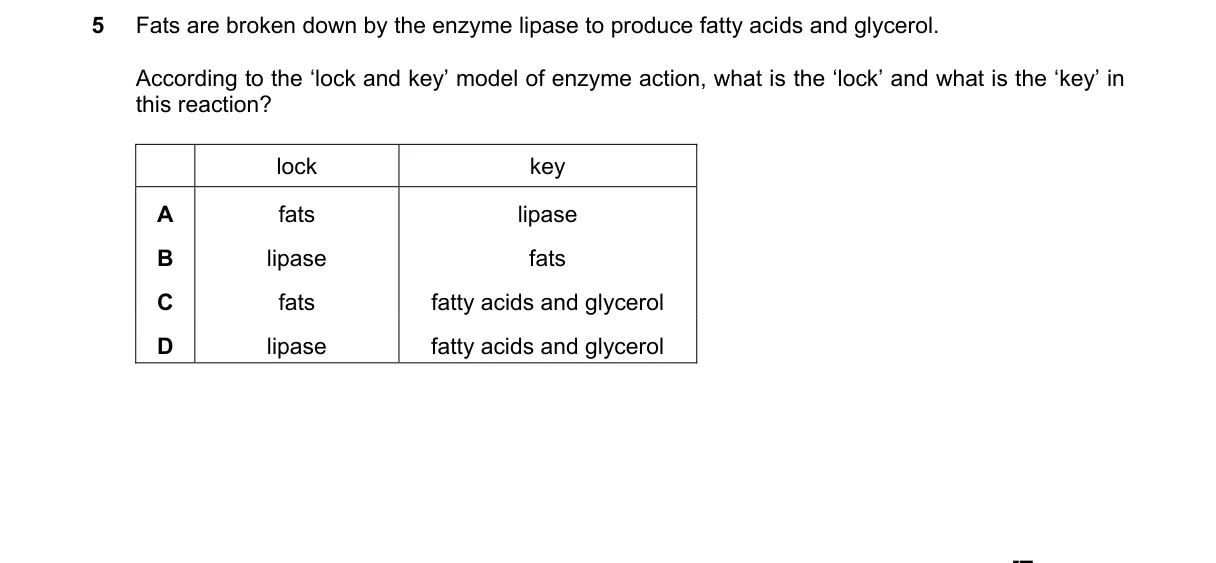
Answer choices
- Alock: fats, key: lipase
- Block: lipase, key: fats
- Clock: fats, key: fatty acids and glycerol
- Dlock: lipase, key: fatty acids and glycerol
Explanation
Lock and Key Model in Enzyme Action
Steps:
- Recall the lock and key model: the enzyme's active site (lock) fits the substrate (key) precisely for reaction.
- Identify the enzyme: lipase, which catalyzes the breakdown.
- Identify the substrate: fats, the molecule being broken down.
- Match to model: enzyme as lock, substrate as key.
Why B is correct:
- In the lock and key model, the enzyme (lipase) is the lock with a specific active site shape, and the substrate (fats) is the key that fits it to form the enzyme-substrate complex.
Why the others are wrong:
- A: Reverses roles; substrate is key, not enzyme.
- C: Fatty acids and glycerol are products, not the key (substrate).
- D: Fatty acids and glycerol are products, not the key.
Final answer: B
Topic: Enzyme action
Practice more O Levels/IGCSE Biology (5090) questions on mMCQ.me