O Levels/IGCSE Biology (5090)•5090/12/O/N/22
O Levels/IGCSE Biology (5090) — 5090/12/O/N/22, Question 40
The gene for insulin production can be transferred from human DNA into bacterial DNA. These bacteria are cultured to produce human insulin. What is an advantage to patients of using this type of human insulin instead of insulin from other animals?
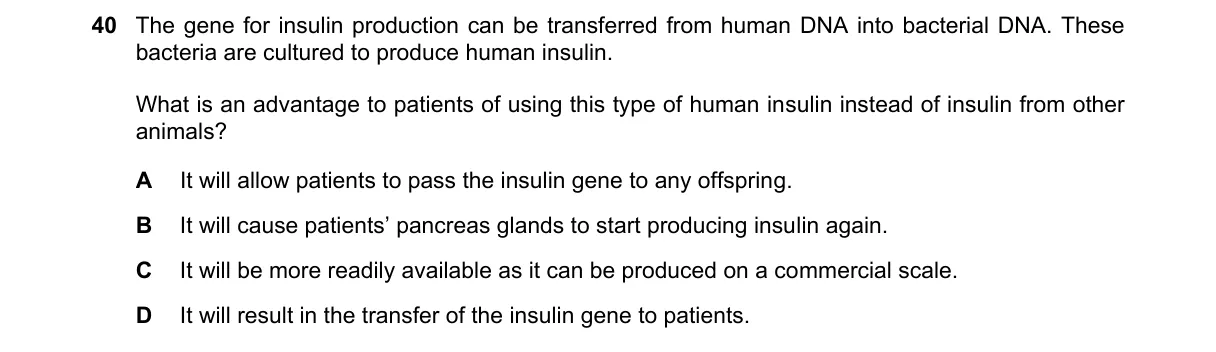
Answer choices
- AIt will allow patients to pass on the gene for type 1 diabetes.
- BIt will cause patients pancreas glands to start producing insulin again.
- CIt will be more readily available as it can be produced on a commercial scale.
- DIt will result in the transfer of the insulin gene to patients.
Explanation
Recombinant insulin production benefits
Steps:
- Identify the process: Human insulin gene is inserted into bacteria, which replicate and produce insulin in large quantities.
- Compare to animal insulin: Animal sources are limited by slaughter and extraction, while bacteria enable mass production.
- Evaluate advantages: Focus on availability, purity, and scalability for patient use.
- Eliminate misconceptions: Rule out genetic transfer or physiological changes in patients.
Why C is correct:
- Bacterial cultures allow unlimited, cost-effective scaling via fermentation, ensuring consistent supply unlike finite animal sources.
Why the others are wrong:
- A: Insulin therapy treats symptoms but does not alter or pass on diabetes genes.
- B: Exogenous insulin replaces missing production but does not restore pancreatic function.
- D: Administered insulin is a protein, not a gene, so no DNA transfer occurs to patients.
Final answer: C
Topic: Genetic modification
Practice more O Levels/IGCSE Biology (5090) questions on mMCQ.me