O Levels/IGCSE Biology (5090)•5090/12/O/N/22
O Levels/IGCSE Biology (5090) — 5090/12/O/N/22, Question 38
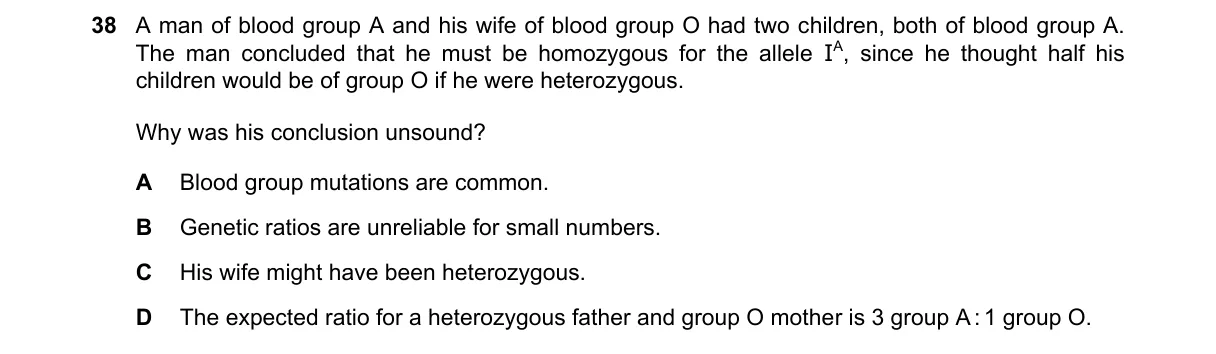
A man of blood group A and his wife of blood group O had two children, both of blood group A. The man concluded that he must be homozygous for the A allele, since he thought half his children would be O if he were heterozygous. Why was his conclusion unsound?
Answer choices
- ABlood group mutations are common.
- BGenetic ratios are unreliable for small numbers.
- CHis wife may have been heterozygous.
- DThe expected ratio for a heterozygous father and group O mother is 3 A:1 O.
Explanation
Small sample sizes mislead genetic conclusions
Steps:
- Man's blood group A means genotype IA IA (homozygous) or IA i (heterozygous); wife's O means ii (homozygous recessive).
- If man heterozygous, each child has 50% chance of A (IA i) or O (ii), so expected 1:1 ratio.
- Two A children possible by chance (probability 0.25), but doesn't rule out heterozygous father.
- Small family size (n=2) can't confirm ratios; larger samples needed for reliability.
Why B is correct:
- Mendel's law of segregation predicts ratios as probabilities over many offspring; small numbers follow binomial distribution, allowing deviations by chance.
Why the others are wrong:
- A: Blood group alleles are stable; mutations rare and irrelevant here.
- C: Group O is always ii, homozygous recessive—no heterozygosity possible.
- D: Heterozygous father (IA i) and O mother (ii) yield 1 A:1 O, not 3:1 (which requires different cross).
Final answer: B
Topic: Inheritance
Practice more O Levels/IGCSE Biology (5090) questions on mMCQ.me