O Levels/IGCSE Biology (5090)•5090/12/O/N/22
O Levels/IGCSE Biology (5090) — 5090/12/O/N/22, Question 20
What are two main functions of the kidneys?
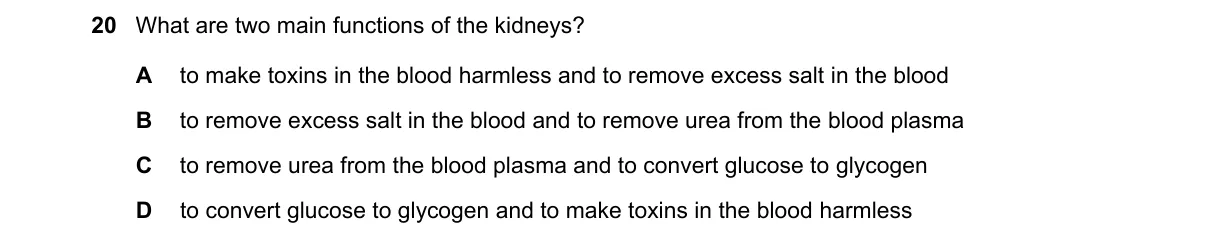
Answer choices
- Ato remove excess salt in the blood and to remove urea from the blood plasma
- Bto remove toxins in the blood and to remove urea from the blood plasma
- Cto remove urea from the blood plasma and to convert glucose to glycogen
- Dto convert glucose to glycogen and to make toxins in the blood harmless
Explanation
Kidneys' Roles in Filtration and Waste Removal
Steps:
- Recall that kidneys filter blood to maintain homeostasis by removing waste products.
- Identify main functions: excretion of urea (from protein breakdown) and elimination of toxins like drugs or metabolic byproducts.
- Evaluate options against these functions: check for accurate waste removal without unrelated processes.
- Select the option matching both urea removal and toxin elimination.
Why B is correct:
- Kidneys act as filters in the nephrons, removing urea (nitrogenous waste) and toxins from blood plasma via glomerular filtration and tubular reabsorption/secretion, as defined in renal physiology.
Why the others are wrong:
- A: Kidneys regulate salt but primary functions focus on broader toxins, not just excess salt.
- C: Urea removal is correct, but glucose-to-glycogen conversion occurs in the liver, not kidneys.
- D: Glucose conversion is a liver function; kidneys detoxify but do not produce toxins.
Final answer: B
Topic: Urinary system
Practice more O Levels/IGCSE Biology (5090) questions on mMCQ.me