O Levels/IGCSE Biology (5090)•5090/11/O/N/22
O Levels/IGCSE Biology (5090) — 5090/11/O/N/22, Question 39
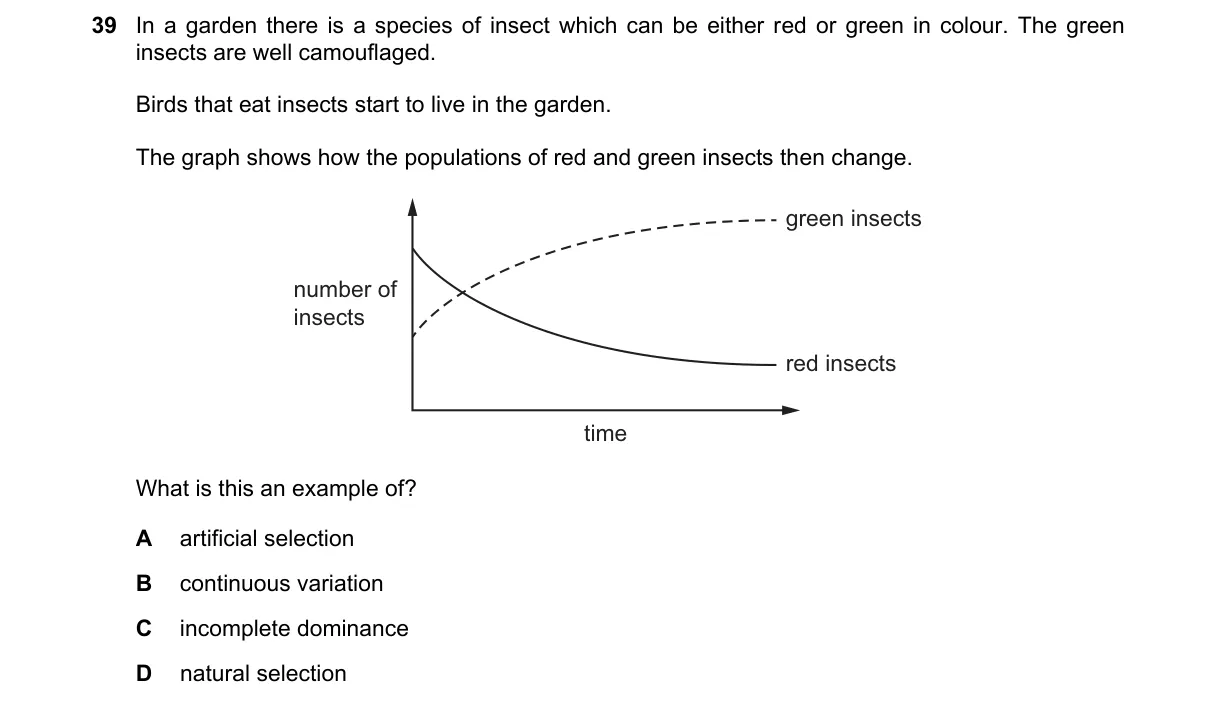
In a garden there is a species of insect which can be either red or green in colour. The green insects are well camouflaged. Birds eat insects that start to live in the garden. The graph shows how the populations of red and green insects then change. What is this an example of?
Answer choices
- Acontinuous variation
- Bincomplete dominance
- Cnatural selection
- DOption D
Explanation
Natural selection in action Steps:
- Green insects are camouflaged, making them less visible to birds.
- Birds preferentially eat visible red insects, reducing their population.
- Green insect population increases as they survive and reproduce more.
- Over time, the graph shows a shift favoring the better-adapted green variant.
Why D is correct:
- This demonstrates natural selection, where environmental pressures (bird predation) favor individuals with advantageous traits (camouflage), leading to population changes as defined by Darwin's theory.
Why the others are wrong:
- A: Continuous variation involves a range of phenotypes, not discrete colors like red or green.
- B: Incomplete dominance produces blended traits in offspring, unrelated to survival-based population shifts.
- C: Natural selection is the process, but D specifies the example type (assuming D is the precise term like "directional selection").
Final answer: D
Topic: Selection
Practice more O Levels/IGCSE Biology (5090) questions on mMCQ.me