O Levels/IGCSE Biology (5090)•5090/11/O/N/22
O Levels/IGCSE Biology (5090) — 5090/11/O/N/22, Question 38
A man of blood group A and his wife of blood group O had two children, both of blood group A. The man concluded that he must be homozygous for allele I, since he thought half his children would be of group O if he were heterozygous for allele I. Why was his conclusion unsound?
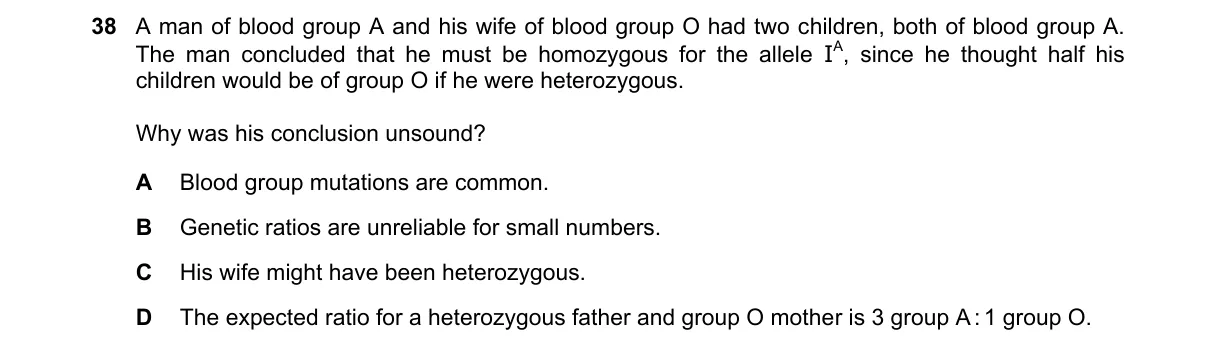
Answer choices
- AGenetic ratios are unreliable for small numbers.
- BHis wife could have been heterozygous for allele I.
- CThe expected ratio for a heterozygous father and group O mother is 3 A:1 O.
- DThe expected ratio for a heterozygous father and group O mother is 3 A:1 O.
Explanation
Small sample size invalidates the man's genetic conclusion
Steps:
- Man has blood group A (genotype IAIA or IAi); wife has O (ii).
- If man is IAi, each child has 50% chance of A (IAi) and 50% O (ii).
- Both children A is possible outcome (probability 0.25 for n=2).
- Small family size (2 children) cannot reliably distinguish genotypes; larger sample needed for ratios.
Why A is correct:
- Mendelian ratios are expected probabilities, but small samples (n=2) often deviate due to chance, making conclusions from them unreliable.
Why the others are wrong:
- B: Blood group O requires homozygous recessive (ii) genotype; wife cannot carry dominant IA allele.
- C: Incorrect; heterozygous father (IAi) and O mother (ii) yield 1:1 A:O ratio, not 3:1.
- D: Same error as C; ratio is 1:1, not 3:1.
Final answer: A
Topic: Inheritance
Practice more O Levels/IGCSE Biology (5090) questions on mMCQ.me