O Levels/IGCSE Biology (5090)•5090/11/O/N/22
O Levels/IGCSE Biology (5090) — 5090/11/O/N/22, Question 37
A variety of snail has an inherited condition that affects the thickness of the shell. S'S' have thick shells. S'S' have thin shells. S's do not survive. Two heterozygous snails are mated. What is the probability that a surviving snail of the next generation is a heterozygote?
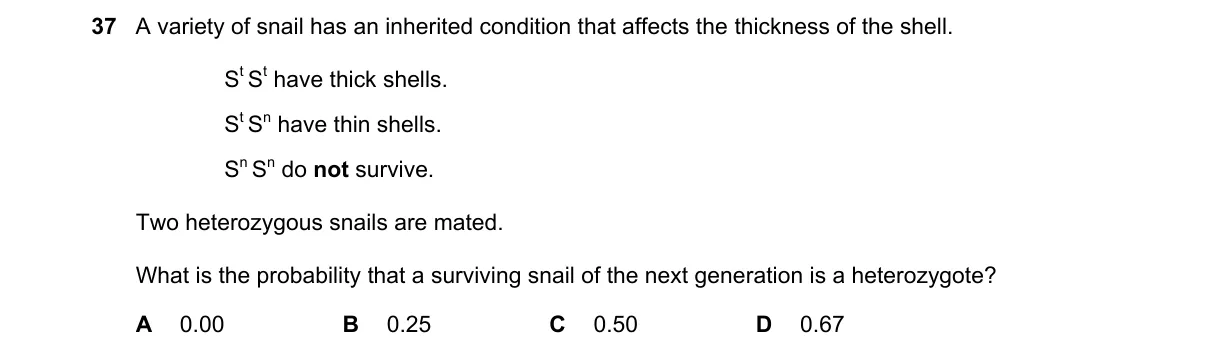
Answer choices
- A0.0
- B0.25
- C0.50
- D0.67
Explanation
Conditional Probability in Lethal Allele Inheritance
Steps:
- Cross two heterozygotes (Ss × Ss): offspring ratios are ¼ SS (thick), ½ Ss (thin), ¼ ss (non-surviving).
- Surviving offspring total ¾ (SS + Ss).
- Heterozygotes (Ss) among survivors: (½) / (¾) = ⅔.
- Thus, probability a surviving snail is heterozygous is 0.67.
Why D is correct:
- In lethal recessive inheritance, the conditional probability formula—P(heterozygote | survival) = P(heterozygote and survival) / P(survival)—yields ⅔ for Ss among viable offspring.
Why the others are wrong:
- A: Incorrect, as heterozygotes survive (ss is lethal).
- B: Matches frequency of SS overall, not conditional on survival.
- C: Matches unconditional heterozygote frequency (½), ignoring lethality.
Final answer: D
Topic: Inheritance
Practice more O Levels/IGCSE Biology (5090) questions on mMCQ.me