O Levels/IGCSE Biology (5090)•5090/11/O/N/22
O Levels/IGCSE Biology (5090) — 5090/11/O/N/22, Question 33
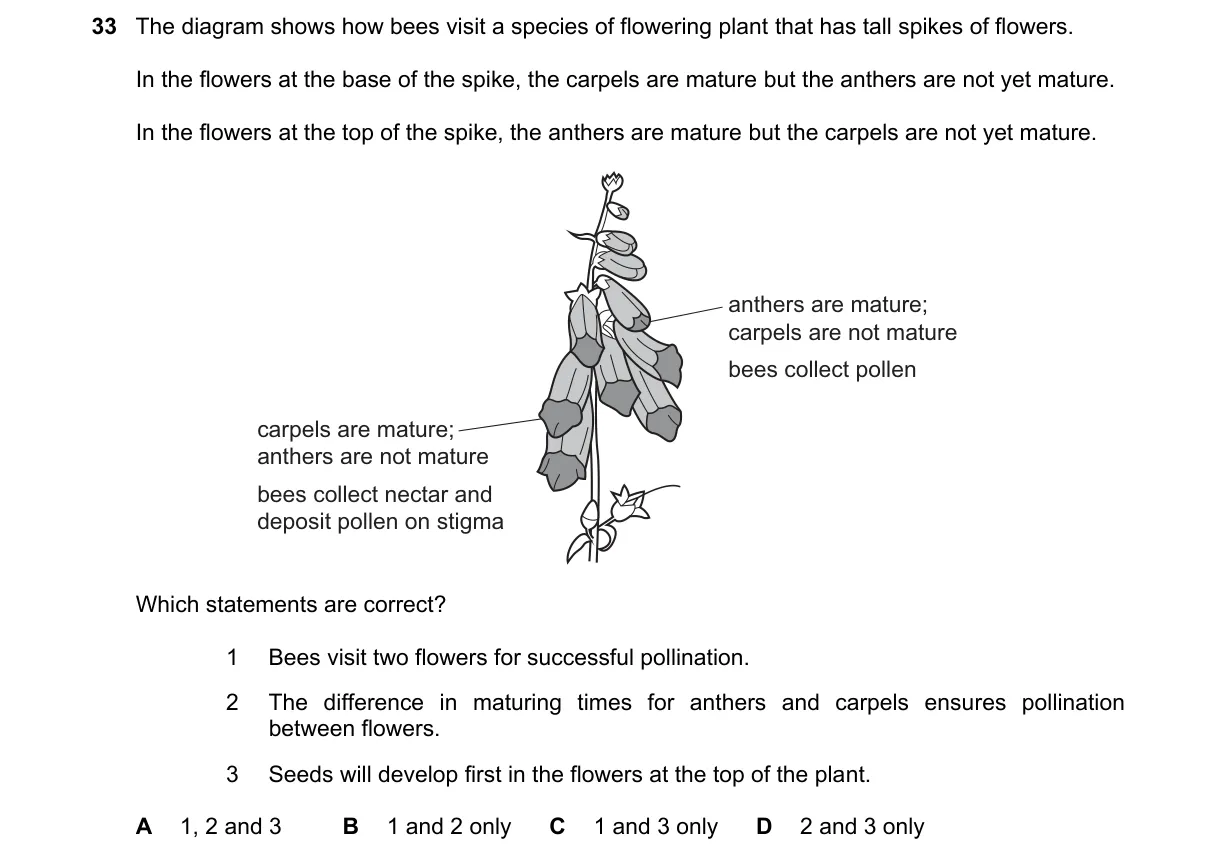
The diagram shows how bees visit a species of flowering plant that has tall spikes of flowers. In the flowers at the base of the spike, the carpels are mature but the anthers are not yet mature. In the flowers at the top of the spike, the anthers are mature but the carpels are not yet mature. Which 1 Bees visit twice for successful pollination. 2 The difference in maturing times for anthers and carpels ensures pollination 3 Seeds will develop first in the flowers at the top of the.
Answer choices
- A1, 2 and 3
- B1 and 2 only
- C1 and 3 only
- D2 and 3 only
Explanation
Temporal separation ensures cross-pollination in spikes
Steps:
- Flowers at base have mature carpels (female parts ready for pollen) but immature anthers (male parts not shedding pollen).
- Flowers at top have mature anthers (shedding pollen) but immature carpels (not ready to receive pollen).
- Bees first visit top flowers, picking up pollen on bodies without depositing any (no mature carpels there).
- Bees then visit base flowers, depositing pollen from top onto mature carpels, enabling pollination; second visit to new spikes repeats for ongoing success.
Why B is correct:
- Statement 2 aligns with dichogamy, where anther-carpel maturity differences prevent self-pollination and promote cross-pollination by forcing pollen transfer between flowers.
Why the others are wrong:
- A includes 3, which is false as seeds develop first at base (mature carpels receive pollen first).
- C includes 3, which misstates seed development sequence.
- D excludes 1, but bees must visit twice (top then base) for pollen pickup and delivery.
Final answer: B
Topic: Sexual reproduction in plants
Practice more O Levels/IGCSE Biology (5090) questions on mMCQ.me