O Levels/IGCSE Biology (5090)•5090/11/O/N/22
O Levels/IGCSE Biology (5090) — 5090/11/O/N/22, Question 21
Which changes occur when a person walks from a cold room into a hot room?
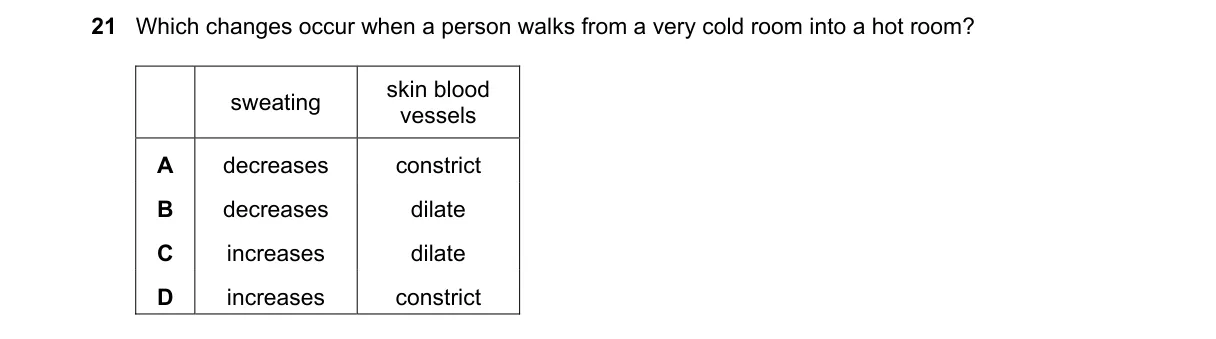
Answer choices
- ASweating decreases, skin blood vessels constrict
- BSweating decreases, skin blood vessels dilate
- CSweating increases, skin blood vessels dilate
- DSweating increases, skin blood vessels constrict
Explanation
Thermoregulation response to heat exposure
Steps:
- Body's hypothalamus detects rising core temperature from hot room.
- Activates sweating to promote evaporative cooling and heat loss.
- Triggers vasodilation of skin blood vessels to increase blood flow and radiate heat.
- These changes restore thermal balance via negative feedback.
Why C is correct:
- In thermoregulation, heat stress increases sweating for evaporation and dilates skin vessels to enhance convective heat loss, per homeostatic principles.
Why the others are wrong:
- A: Both changes oppose cooling; constriction retains heat, sweating decrease reduces evaporation.
- B: Sweating decrease hinders cooling despite dilation aiding heat loss.
- D: Vasoconstriction retains heat, countering the cooling effect of increased sweating.
Final answer: C
Topic: Temperature control
Practice more O Levels/IGCSE Biology (5090) questions on mMCQ.me