O Levels/IGCSE Biology (5090)•5090/12/O/N/21
O Levels/IGCSE Biology (5090) — 5090/12/O/N/21, Question 40
During division of nucleus in meiosis, changes can happen that produce a gamete with abnormal number of genes or chromosomes. Which change might produce a gamete that can result in a child having Down's syndrome?
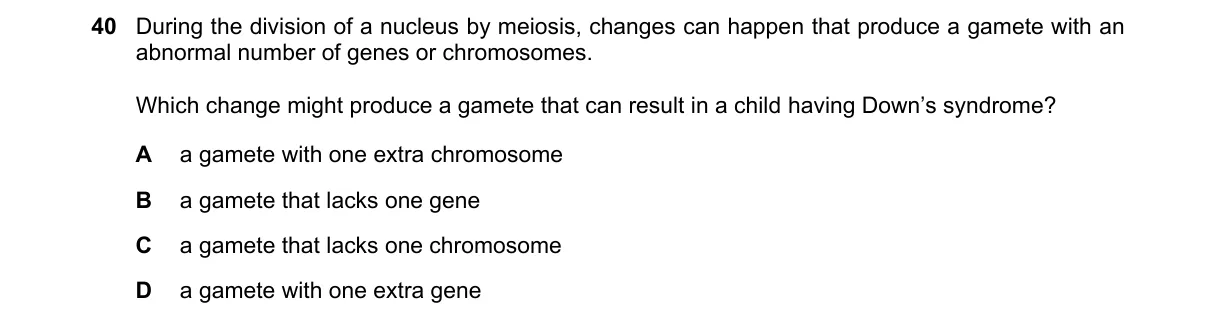
Answer choices
- Aa gamete with one extra chromosome
- Ba gamete that lacks one gene
- Ca gamete that lacks one chromosome
- Da gamete with one extra gene
Explanation
Nondisjunction in meiosis causing trisomy 21
Steps:
- Meiosis normally halves chromosomes to 23 per gamete for proper fertilization.
- Down's syndrome results from trisomy 21, an extra chromosome 21 in the child.
- If a gamete has 24 chromosomes (extra 21), fertilization with a normal 23-chromosome gamete yields 47 chromosomes total.
- This extra chromosome 21 directly causes Down's syndrome traits.
Why A is correct:
- Trisomy 21, defining Down's syndrome, occurs when a gamete with an extra chromosome 21 fuses with a normal one, per Mendelian inheritance principles.
Why the others are wrong:
- B: Lacking one gene may cause monogenic disorders but not the chromosomal trisomy of Down's.
- C: Lacking one chromosome leads to monosomy (e.g., Turner syndrome), not trisomy.
- D: An extra gene alters a single locus but does not produce the full extra chromosome seen in Down's.
Final answer: A
Topic: Nuclear division
Practice more O Levels/IGCSE Biology (5090) questions on mMCQ.me