O Levels/IGCSE Biology (5090)•5090/12/O/N/21
O Levels/IGCSE Biology (5090) — 5090/12/O/N/21, Question 38
One gene has two codominant alleles, A¹ and A², and one recessive allele, a. How many different genotypes and phenotypes are possible?
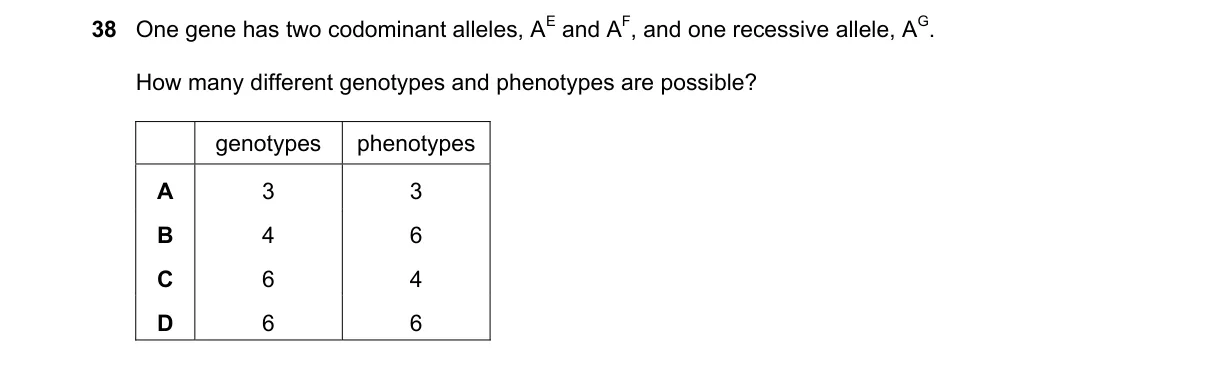
Answer choices
- A3 genotypes, 3 phenotypes
- B4 genotypes, 3 phenotypes
- C6 genotypes, 4 phenotypes
- D6 genotypes, 6 phenotypes
Explanation
Genotypes and phenotypes from three alleles with codominance and recessiveness
Steps:
- For three alleles (A¹, A², a) in diploid organisms, calculate genotypes using formula n(n+1)/2 where n=3, yielding 6: A¹A¹, A¹A², A¹a, A²A², A²a, aa.
- A¹ and A² are codominant, so A¹A² expresses both traits; a is recessive to both.
- Assign phenotypes: A¹A¹ (A¹ trait), A²A² (A² trait), A¹A² (A¹ + A² traits), A¹a (A¹ trait), A²a (A² trait), aa (recessive trait).
- Distinct phenotypes total 4: A¹ only, A² only, A¹ + A², recessive.
Why C is correct:
- Three alleles produce 6 genotypes per the multiple alleles formula; codominance and recessiveness yield 4 phenotypes as heterozygotes A¹a and A²a match homozygous dominant expressions.
Why the others are wrong:
- A: Assumes biallelic dominance (3 genotypes, 3 phenotypes), ignoring third allele.
- B: Counts only 4 genotypes, mistaking for two alleles, and undercounts phenotypes.
- D: Correct on 6 genotypes but overcounts phenotypes at 6, ignoring codominance merging some expressions.
Final answer: C
Topic: Inheritance
Practice more O Levels/IGCSE Biology (5090) questions on mMCQ.me