O Levels/IGCSE Biology (5090)•5090/11/O/N/21
O Levels/IGCSE Biology (5090) — 5090/11/O/N/21, Question 8
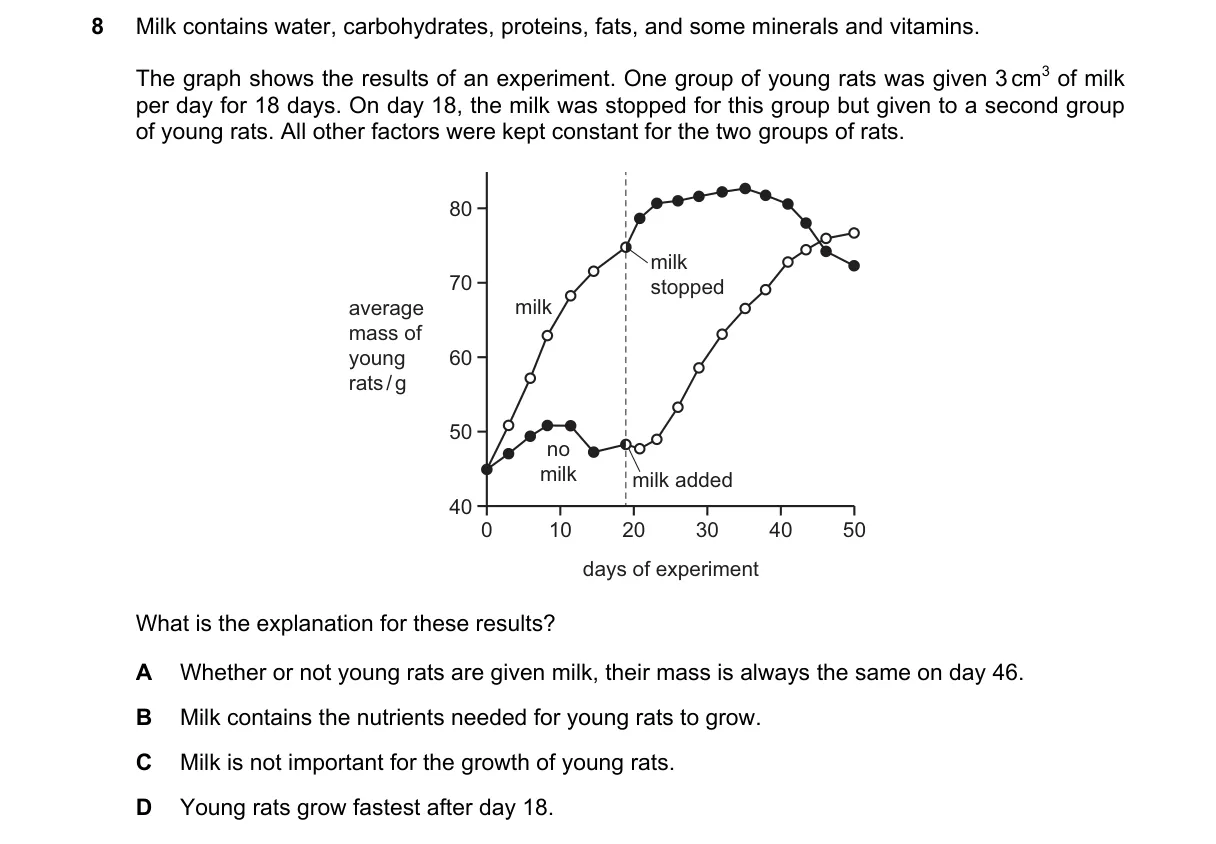
Milk contains water, carbohydrates, proteins, fats, and some minerals and vitamins. Milk was given per day for 18 days to two groups of young rats. On day 18, the milk was stopped for one group but was given 3 cm³ of milk per day to the second group of rats. All other factors were kept constant for the two groups of rats. The graph shows average mass of young rats over 50 days of experiment, with one line plateauing after day 18 (no milk) and the other continuing to increase (milk added). What is the explanation for these results?
Answer choices
- AWhether or not young rats are given milk, their mass is always the same on day 46.
- BMilk is not important for the growth of young rats.
- CYoung rats grow faster after day 18.
- DMilk contains the nutrients needed for the growth of young rats.
Explanation
Milk Enables Continued Growth in Rats
Steps:
- Examine the graph: the no-milk group plateaus after day 18, showing no further mass gain.
- Compare to the milk group: mass continues increasing after day 18 with 3 cm³ milk daily.
- Note controlled conditions: differences result solely from milk presence.
- Conclude milk supplies growth-essential nutrients, as its absence halts development.
Why D is correct:
- The controlled experiment isolates milk's role; continued mass gain with milk versus stagnation without proves it provides required carbohydrates, proteins, fats, minerals, and vitamins for growth.
Why the others are wrong:
- A: Masses differ on day 46; milk group is heavier due to ongoing growth.
- B: Milk is vital, as its removal stops mass increase.
- C: No acceleration; one group merely maintains prior growth rate, the other halts.
Final answer: D
Topic: Diet
Practice more O Levels/IGCSE Biology (5090) questions on mMCQ.me