O Levels/IGCSE Biology (5090)•5090/11/O/N/21
O Levels/IGCSE Biology (5090) — 5090/11/O/N/21, Question 25
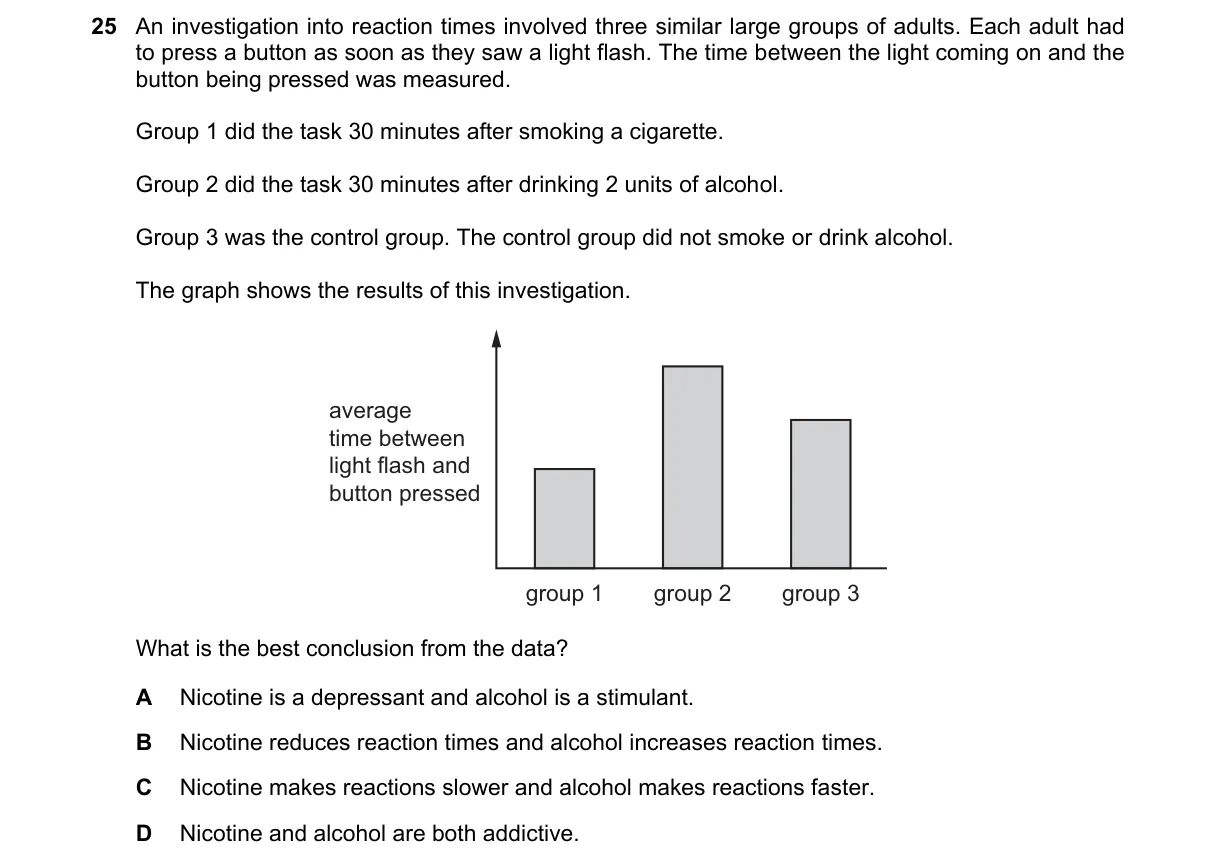
An investigation into reaction times involved three large groups of adults. Each had to press a button as soon as they saw a light flash. The time between the light coming on and the button being pressed was measured. Group 1 did the task 30 minutes after smoking a cigarette. Group 2 did the task 30 minutes after drinking 2 units of alcohol. Group 3 was the control group. The control group did not smoke or drink alcohol. The graph shows the results of this investigation. time between light flash and button pressed [graph with bars: shorter for group 1, longer for group 2, medium for group 3]. What is the best conclusion from the data?
Answer choices
- ANicotine is a depressant and alcohol is a stimulant.
- BNicotine reduces reaction times and alcohol increases reaction times.
- CNicotine and alcohol are both addictive.
- DNicotine makes reactions slower and alcohol makes reactions faster.
Explanation
Substances' effects on reaction times from graph data
Steps:
- Examine graph bars: Group 1 (nicotine) has shortest time, indicating fastest reactions.
- Group 2 (alcohol) has longest time, indicating slowest reactions.
- Group 3 (control) has medium time, serving as baseline without substances.
- Conclude nicotine shortens reaction time while alcohol lengthens it compared to control.
Why B is correct:
- Reaction time measures speed from stimulus to response; data shows nicotine decreases it (shorter bar) and alcohol increases it (longer bar), aligning with observed effects.
Why the others are wrong:
- A: Incorrectly labels nicotine as depressant (it speeds reactions) and alcohol as stimulant (it slows them).
- C: Data addresses reaction times, not addiction properties.
- D: Reverses findings—nicotine speeds reactions, alcohol slows them.
Final answer: B
Topic: Mammalian nervous system
Practice more O Levels/IGCSE Biology (5090) questions on mMCQ.me