O Levels/IGCSE Biology (5090)•5090/11/O/N/20
O Levels/IGCSE Biology (5090) — 5090/11/O/N/20, Question 19
During dialysis, substances such as glucose, mineral salts and water move between the patient's blood and the dialysis fluid. Which processes are involved in these movements?
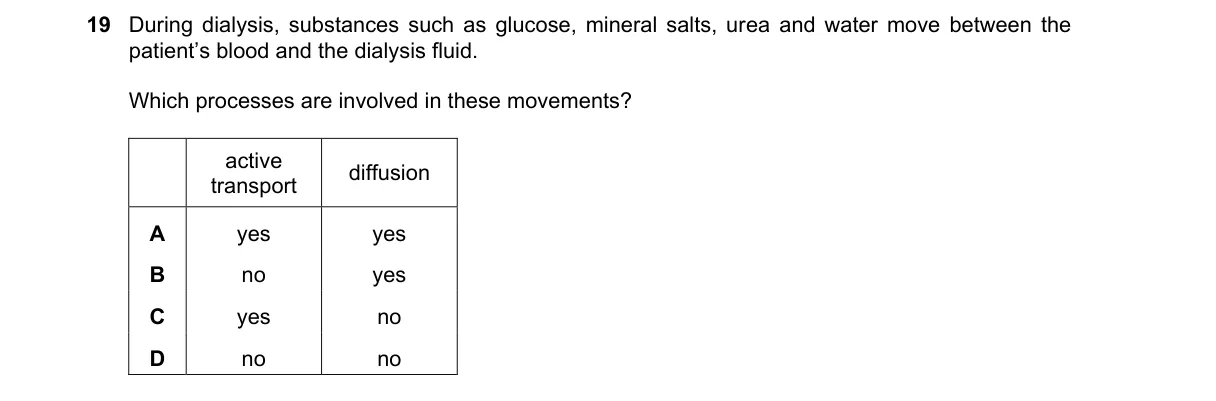
Answer choices
- Aactive transport: no, diffusion: yes
- Bactive transport: yes, diffusion: yes
- Cactive transport: yes, diffusion: no
- Dactive transport: no, diffusion: no
Explanation
Dialysis Uses Diffusion and Active Transport for Solute and Water Movement
Steps:
- Dialysis employs a semi-permeable membrane separating blood from dialysis fluid.
- Glucose and mineral salts move passively down concentration gradients via diffusion.
- Water moves via osmosis, a type of diffusion, to balance osmotic pressure.
- Active transport selectively moves ions like salts against gradients to restore blood balance.
Why B is correct:
- In dialysis, diffusion enables passive transfer of small molecules (per Fick's law of diffusion), while active transport uses energy (ATP) to adjust mineral salt levels against electrochemical gradients.
Why the others are wrong:
- A omits active transport needed for ion regulation.
- C excludes diffusion, the primary mechanism for glucose, salts, and water.
- D ignores both key processes entirely.
Final answer: B
Topic: Diffusion and osmosis
Practice more O Levels/IGCSE Biology (5090) questions on mMCQ.me