O Levels/IGCSE Biology (5090)•5090/11/O/N/20
O Levels/IGCSE Biology (5090) — 5090/11/O/N/20, Question 14
The diagram shows a section of capillary. Which arrow represents tissue fluid formation?
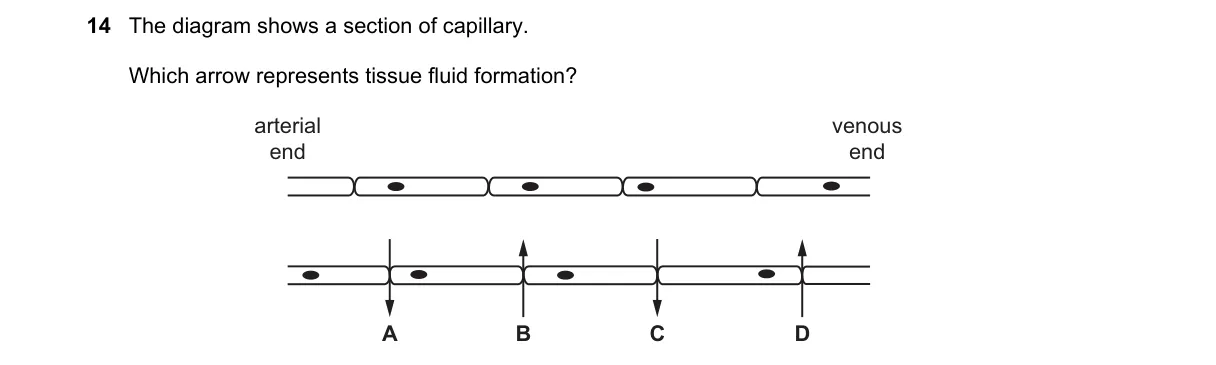
Answer choices
- AOption A
- BOption B
- COption C
- DOption D
Explanation
Capillary Filtration and Tissue Fluid Formation
Steps:
- Identify Starling's hypothesis: hydrostatic pressure exceeds oncotic pressure at arterial end, causing net fluid filtration.
- Locate arrows in diagram: outward arrows indicate filtration from capillary lumen to interstitial space.
- Match to tissue fluid: formation occurs via this outward flow, not reabsorption.
- Confirm A as the arrow depicting this process.
Why A is correct:
- A shows outward flow from capillary, aligning with hydrostatic pressure driving filtration per Starling's forces.
Why the others are wrong:
- B indicates inward flow, representing reabsorption at venous end.
- C points to blood flow within capillary, not fluid exchange.
- D shows osmotic pull, which opposes formation.
Final answer: A
Topic: Blood vessels
Practice more O Levels/IGCSE Biology (5090) questions on mMCQ.me