O Levels/IGCSE Biology (5090)•5090/12/O/N/19
O Levels/IGCSE Biology (5090) — 5090/12/O/N/19, Question 38
Elephants are hunted by poachers for their tusks, which are a source of ivory. In 1990, in a national park, 10% of the elephants were born without tusks. Lack of tusks was the result of a mutation. Currently, in the same park, 10% of the females and 5% of the males are born without tusks. Which statements can explain this increase in the number of tuskless elephants? 1 Tuskless elephants are less likely to be killed by poachers. 2 Tuskless elephants reproduce and pass allele to offspring. 3
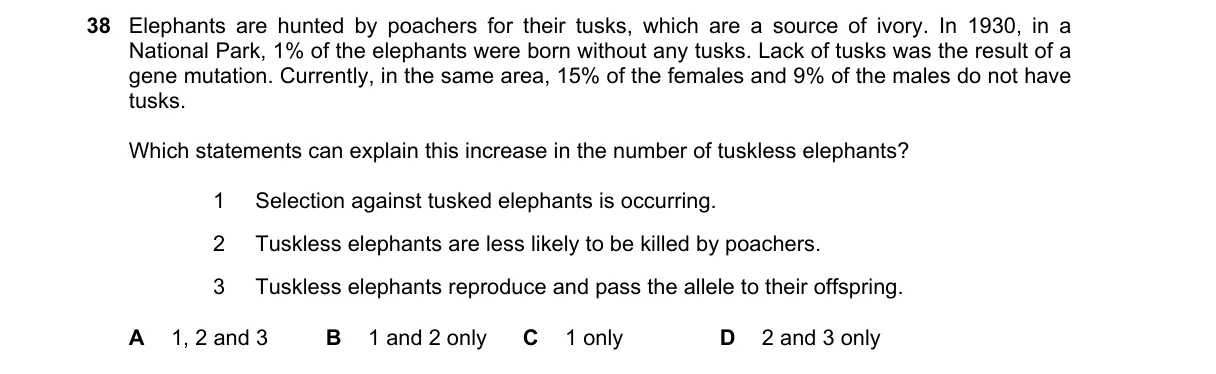
Answer choices
- A1, 2 and 3
- B1 and 2
- C1 only
- D2 and 3
Explanation
Natural selection increases tuskless elephants via poaching pressure
Steps:
- Poaching kills tusked elephants more, increasing tuskless survival (statement 1).
- Tuskless trait is heritable, so survivors pass it to offspring (statement 2).
- Higher female tusklessness (10%) vs. males (5%) suggests X-linked inheritance, amplifying spread in females (statement 3).
- Combined, these explain rise from 10% overall to sex-biased prevalence.
Why A is correct:
- All three statements describe directional selection, heritability, and sex-linked transmission per evolutionary biology principles.
Why the others are wrong:
- B omits sex-linkage, failing to explain male-female difference.
- C ignores heritability and sex-linkage, missing genetic propagation.
- D excludes poaching survival advantage, the primary selective force.
Final answer: A
Topic: Selection
Practice more O Levels/IGCSE Biology (5090) questions on mMCQ.me