O Levels/IGCSE Biology (5090)•5090/12/O/N/19
O Levels/IGCSE Biology (5090) — 5090/12/O/N/19, Question 3
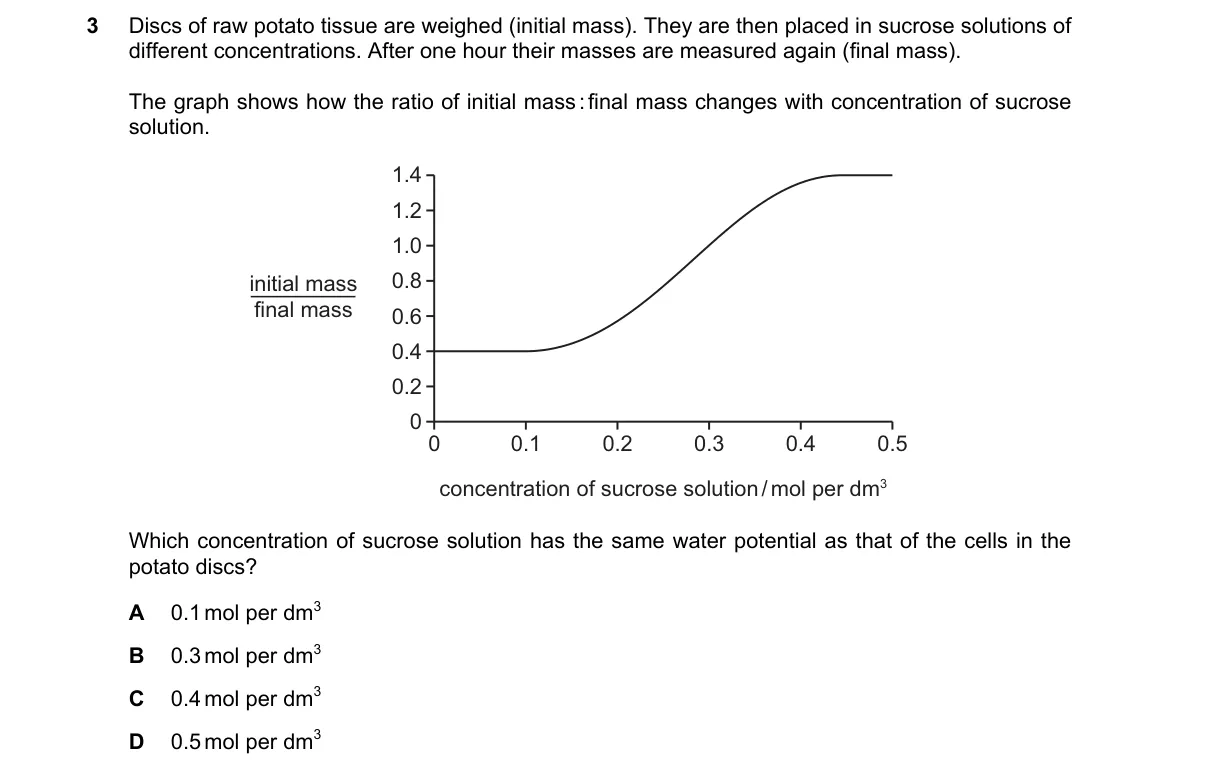
Discs of potato tissue are weighed initial mass. They are placed in sucrose solutions of different concentrations. After one hour their masses are measured again final mass. The graph shows the ratio of initial mass final mass changes with concentration of sucrose solution. Which concentration of sucrose solution has the same water potential as that of the cells in the potato
Answer choices
- A0.1 mol dm
- B0.3 mol dm
- C0.4 mol dm
- D0.5 mol dm
Explanation
No net mass change indicates equal water potential
Steps:
- Identify the point on the graph where the mass ratio is 1 (no change in mass).
- This occurs when water potential of potato cells equals that of the sucrose solution.
- Locate the concentration corresponding to this point.
- The graph shows this at 0.3 mol dm⁻³.
Why B is correct:
- At equal water potentials, osmosis causes no net water movement, so mass remains unchanged (water potential equilibrium).
Why the others are wrong:
- A: Lower concentration means higher solution water potential, causing water influx and mass increase.
- C: Higher concentration means lower solution water potential, causing water efflux and mass decrease.
- D: Even higher concentration amplifies water loss, leading to greater mass decrease.
Final answer: B
Topic: Diffusion and osmosis
Practice more O Levels/IGCSE Biology (5090) questions on mMCQ.me