O Levels/IGCSE Biology (5090)•5090/12/O/N/19
O Levels/IGCSE Biology (5090) — 5090/12/O/N/19, Question 10
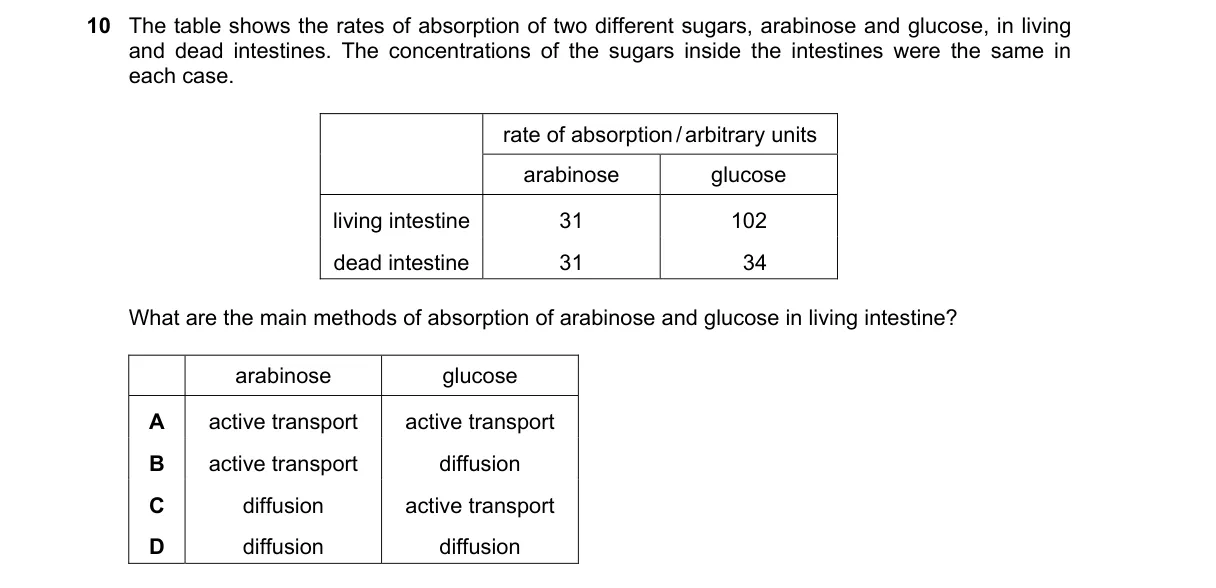
The table shows rates of absorption of two different sugars, arabinose and glucose in living and dead intestines. The concentrations of the two sugars inside the intestines were the same in each case. Living intestine: arabinose 31, glucose 102. Dead intestine: arabinose 31, glucose 34. What are the methods of absorption of arabinose and glucose in intestine?
Answer choices
- Aarabinose active transport, glucose active transport
- Barabinose diffusion, glucose active transport
- Carabinose active transport, glucose diffusion
- Darabinose diffusion, glucose diffusion
Explanation
Active vs. Passive Absorption in Living vs. Dead Tissue
Steps:
- Active transport requires energy from living cells and stops in dead tissue; diffusion occurs passively in both.
- Arabinose shows identical absorption rates (31) in living and dead intestines, indicating no energy dependence.
- Glucose shows a much higher rate in living (102) vs. dead (34) intestines, indicating energy-dependent active transport.
- Thus, arabinose absorbs by diffusion, while glucose uses active transport.
Why B is correct:
- B aligns with the definition of active transport (higher rate only in living tissue due to energy use) and diffusion (unchanged rate in dead tissue).
Why the others are wrong:
- A: Arabinose rate unchanged in dead tissue, ruling out active transport.
- C: Glucose rate drops sharply in dead tissue, requiring active transport; arabinose fits diffusion, not active.
- D: Glucose's elevated living rate exceeds what diffusion alone predicts.
Final answer: B
Topic: Absorption and assimilation
Practice more O Levels/IGCSE Biology (5090) questions on mMCQ.me