O Levels/IGCSE Biology (5090)•5090/11/O/N/19
O Levels/IGCSE Biology (5090) — 5090/11/O/N/19, Question 28
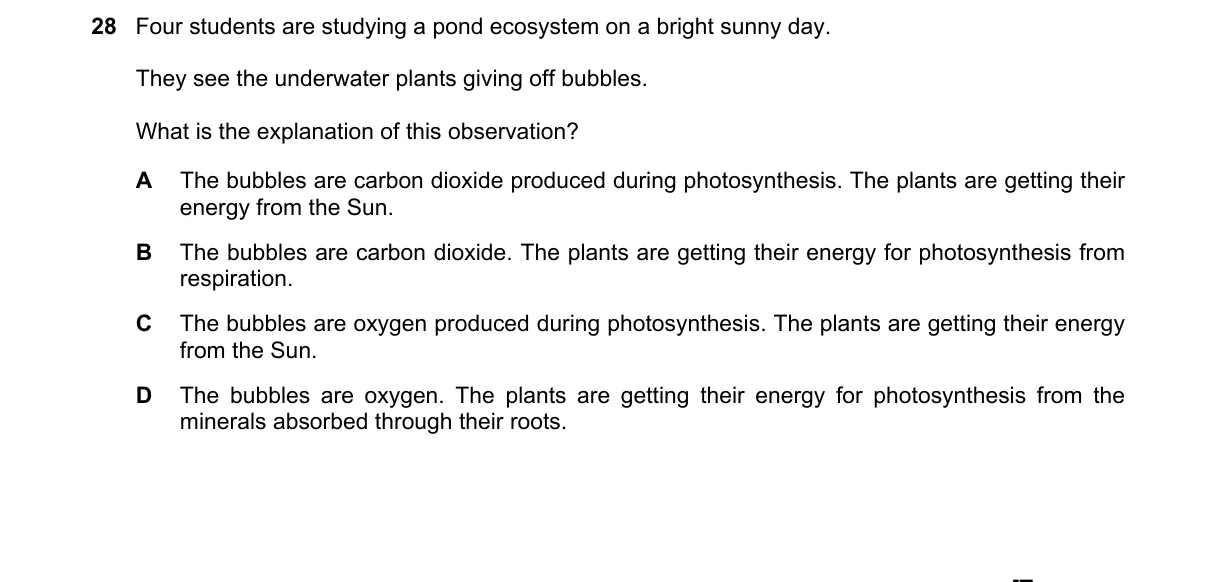
Four students are studying a pond ecosystem on a bright sunny day. They see underwater plants giving off bubbles. What is the explanation of this observation?
Answer choices
- AThe bubbles are carbon dioxide produced during photosynthesis. The plants are getting their energy for photosynthesis from the carbon dioxide.
- BThe bubbles are carbon dioxide from respiration. The plants are getting their energy for photosynthesis from the carbon dioxide.
- CThe bubbles are oxygen produced during photosynthesis. The plants are getting their energy for photosynthesis from the sun.
- DThe plants are getting their energy for photosynthesis from the minerals absorbed through their roots.
Explanation
Photosynthesis releases oxygen bubbles in sunlight
Steps:
- Observe bubbles from underwater plants on a sunny day, indicating active light-dependent processes.
- Recall photosynthesis equation: 6CO₂ + 6H₂O + light → C₆H₁₂O₆ + 6O₂, where oxygen gas is produced.
- Identify bubbles as O₂ released from water splitting in the light reaction.
- Confirm energy source is sunlight, enabling the process.
Why C is correct:
- Photosynthesis's light-dependent stage splits water (photolysis), releasing O₂ as a byproduct, per the equation 2H₂O → 4H⁺ + 4e⁻ + O₂.
Why the others are wrong:
- A: Photosynthesis consumes CO₂, not produces it; energy comes from light, not CO₂.
- B: Respiration releases CO₂ but occurs continuously; sunny conditions favor net O₂ production via photosynthesis.
- D: Photosynthesis energy derives from sunlight, not root-absorbed minerals, which support nutrient uptake.
Final answer: C
Topic: Photosynthesis
Practice more O Levels/IGCSE Biology (5090) questions on mMCQ.me