O Levels/IGCSE Biology (5090)•5090/11/O/N/19
O Levels/IGCSE Biology (5090) — 5090/11/O/N/19, Question 17
What happens during expiration?
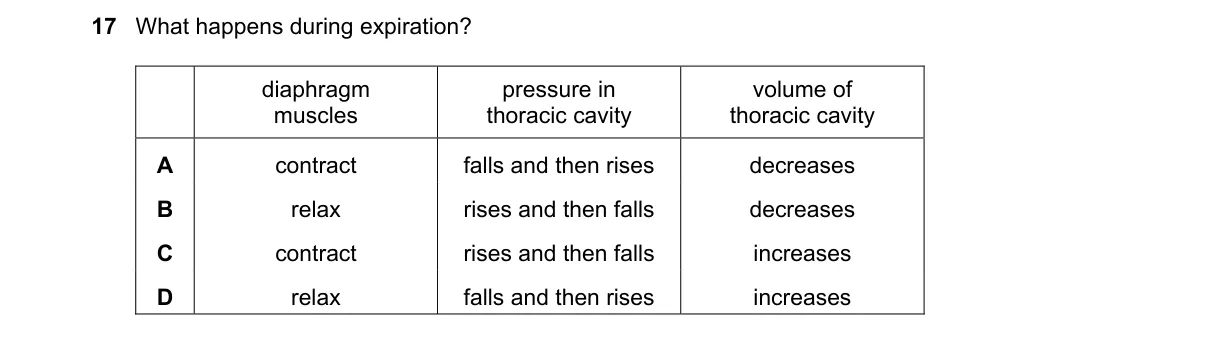
Answer choices
- Adiaphragm muscles contract, pressure in thoracic cavity rises then falls, volume of thoracic cavity decreases
- Bdiaphragm muscles relax, pressure in thoracic cavity rises then falls, volume of thoracic cavity decreases
- Cdiaphragm muscles contract, pressure in thoracic cavity rises and falls, volume of thoracic cavity increases
- Ddiaphragm muscles relax, pressure in thoracic cavity falls then rises, volume of thoracic cavity increases
Explanation
Mechanics of Passive Expiration
Steps:
- Expiration is the exhalation phase where air leaves the lungs.
- The diaphragm relaxes, moving upward to its resting position.
- This reduces the thoracic cavity volume.
- Decreased volume raises intrapulmonary pressure above atmospheric pressure, expelling air.
Why B is correct:
- Diaphragm relaxation decreases thoracic volume, increasing pressure per Boyle's law (pressure inversely proportional to volume), then pressure falls as air exits.
Why the others are wrong:
- A: Diaphragm contracts during inspiration, not expiration.
- C: Diaphragm contraction increases thoracic volume for inspiration.
- D: Pressure falls then rises and volume increase describe inspiration.
Final answer: B
Topic: Human gas exchange
Practice more O Levels/IGCSE Biology (5090) questions on mMCQ.me