O Levels/IGCSE Biology (5090)•5090/12/O/N/18
O Levels/IGCSE Biology (5090) — 5090/12/O/N/18, Question 5
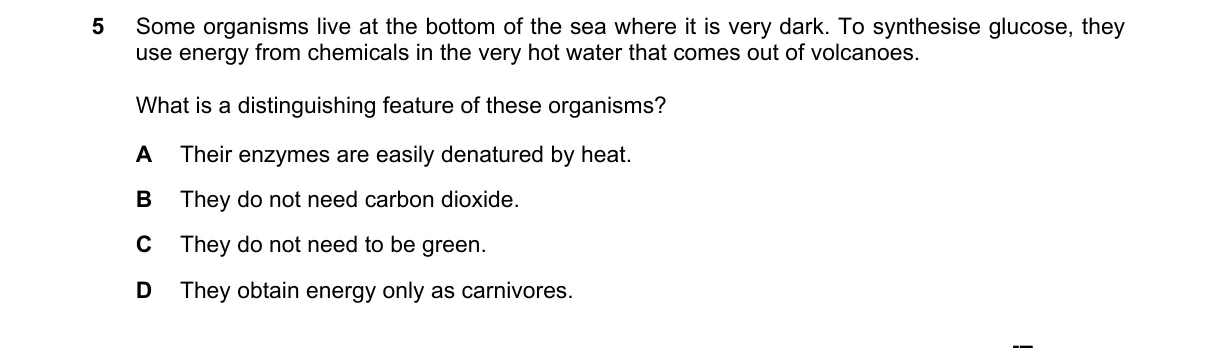
Some organisms live at the bottom of the sea where it is very dark. To synthesize glucose, they use energy from chemicals in the very hot water that comes out of volcanoes.
Answer choices
- ATheir enzymes are easily denatured by heat.
- BThey do not need carbon dioxide.
- COption C
- DThey obtain energy only as carnivores.
Explanation
Chemosynthetic organisms at hydrothermal vents
Steps:
- Recognize the dark, lightless environment rules out photosynthesis for glucose synthesis.
- Note energy source is chemicals from hot volcanic water, indicating chemosynthesis.
- Recall chemosynthesis uses inorganic chemicals (e.g., H2S) to produce organic compounds like glucose via CO2 fixation.
- Match to option C, which describes chemosynthetic autotrophs.
Why C is correct:
- Chemosynthesis definition: Autotrophic process using chemical energy (not light) to convert CO2 and H2O into glucose, as in 6CO2 + 6H2O + energy → C6H12O6 + 6O2, powered by vent chemicals.
Why the others are wrong:
- A: These thermophiles have heat-stable enzymes adapted to high temperatures, not easily denatured.
- B: Chemosynthesizers require CO2 as a carbon source for glucose production.
- D: They are autotrophs making their own food from chemicals, not carnivores relying on prey.
Final answer: C
Topic: Energy flow
Practice more O Levels/IGCSE Biology (5090) questions on mMCQ.me