O Levels/IGCSE Biology (5090)•5090/12/O/N/18
O Levels/IGCSE Biology (5090) — 5090/12/O/N/18, Question 39
The diagram shows a family in which some members suffer from a disease caused by a recessive allele. Which members of the family would be heterozygous for the disease?
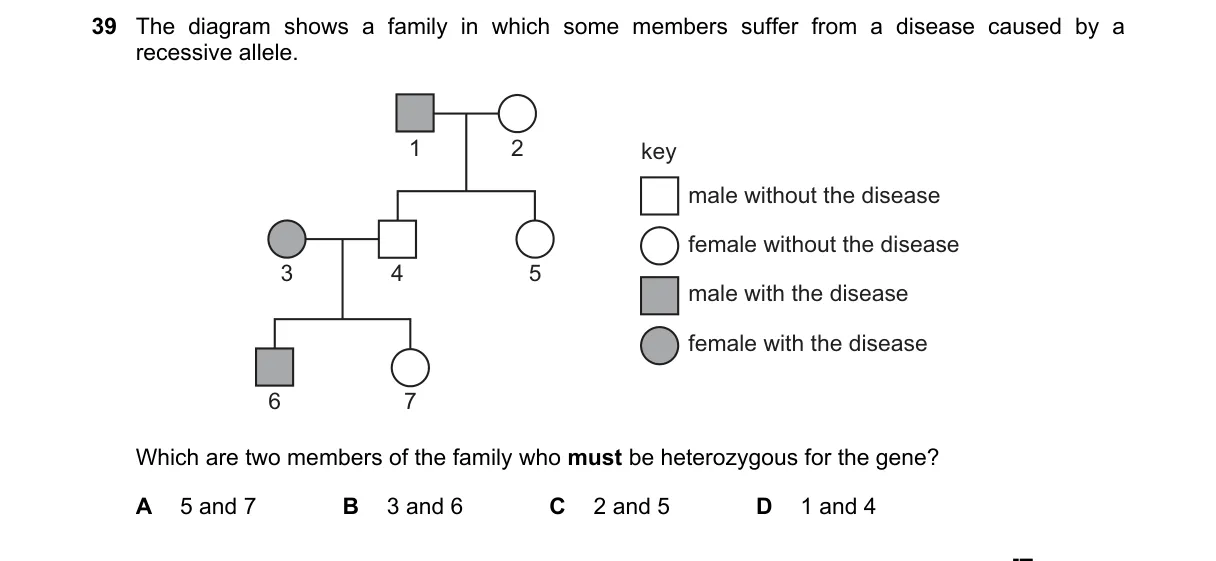
Answer choices
- A5 and 7
- B3 and 6
- C2 and 5
- D1 and 4
Explanation
Identifying carriers in a recessive pedigree Steps:
- Locate affected individuals: they must be homozygous recessive (aa) and show the disease.
- Note unaffected parents of affected offspring: for a recessive trait, both must be heterozygous (Aa) to produce aa children.
- Examine unaffected individuals without affected descendants: they could be AA or Aa, but lack evidence for Aa.
- Confirm heterozygotes only where inheritance patterns require carriers (e.g., unaffected with aa child).
Why A is correct:
- Members 5 and 7 are unaffected but have an affected child, so both must carry the recessive allele (Aa) per Mendelian recessive inheritance.
Why the others are wrong:
- B (3 and 6): 3 is likely affected (aa), not heterozygous; 6 lacks carrier evidence.
- C (2 and 5): 2 is homozygous dominant (AA) as unaffected without affected offspring; 5 is heterozygous but paired wrongly.
- D (1 and 4): Both are unaffected grandparents without direct affected descendants, so possibly AA, not confirmed Aa.
Final answer: A
Topic: Inheritance
Practice more O Levels/IGCSE Biology (5090) questions on mMCQ.me