O Levels/IGCSE Biology (5090)•5090/12/O/N/18
O Levels/IGCSE Biology (5090) — 5090/12/O/N/18, Question 10
A gland secretes different types of enzymes into part of the alimentary canal which allows digestion of proteins and starch. It also receives alkaline secretions from another gland and contains muscles that are used in peristalsis. Which part of the alimentary canal is being described?
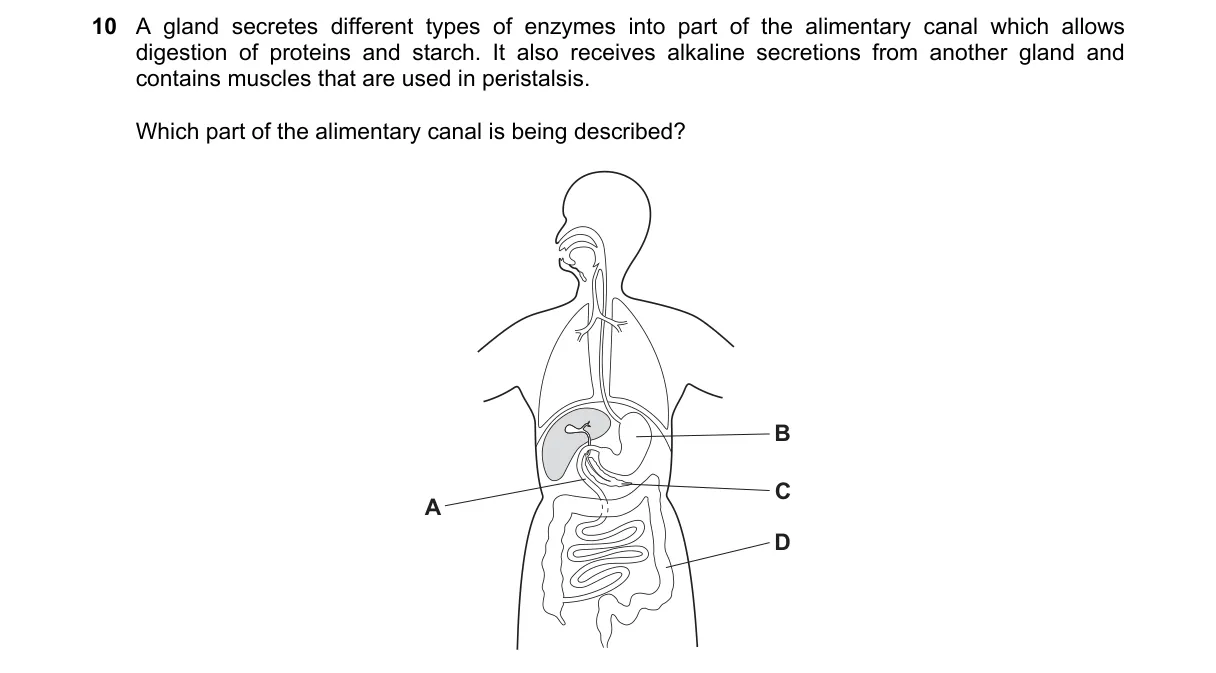
Answer choices
- AOption A
- BOption B
- COption C
- DOption D
Explanation
Duodenum as the site of enzymatic and alkaline digestion
Steps:
- Identify the gland secreting enzymes for proteins (proteases) and starch (amylase): the pancreas.
- Note the delivery site for these enzymes: the duodenum, first part of the small intestine.
- Confirm alkaline secretions from another gland: bile from the liver (via gallbladder) enters the duodenum to neutralize acid and aid digestion.
- Verify presence of peristaltic muscles: the duodenum has smooth muscle layers for mixing and propulsion.
Why A is correct:
- The duodenum receives pancreatic enzymes for protein/starch digestion and hepatic bile for alkalinity, per standard gastrointestinal anatomy.
Why the others are wrong:
- B (stomach): Secretes only pepsin for proteins, no starch enzymes; acidic, not alkaline.
- C (jejunum): Lacks direct pancreatic/liver duct entry; mainly absorption site.
- D (ileum): Focuses on bile acid reabsorption and vitamin uptake, not initial enzyme digestion.
Final answer: A
Topic: Human digestive system
Practice more O Levels/IGCSE Biology (5090) questions on mMCQ.me