O Levels/IGCSE Biology (5090)•5090/11/O/N/18
O Levels/IGCSE Biology (5090) — 5090/11/O/N/18, Question 4
Enzyme action can be explained by the lock and key hypothesis. Where is the active site and does the substrate act as the lock or as the key?
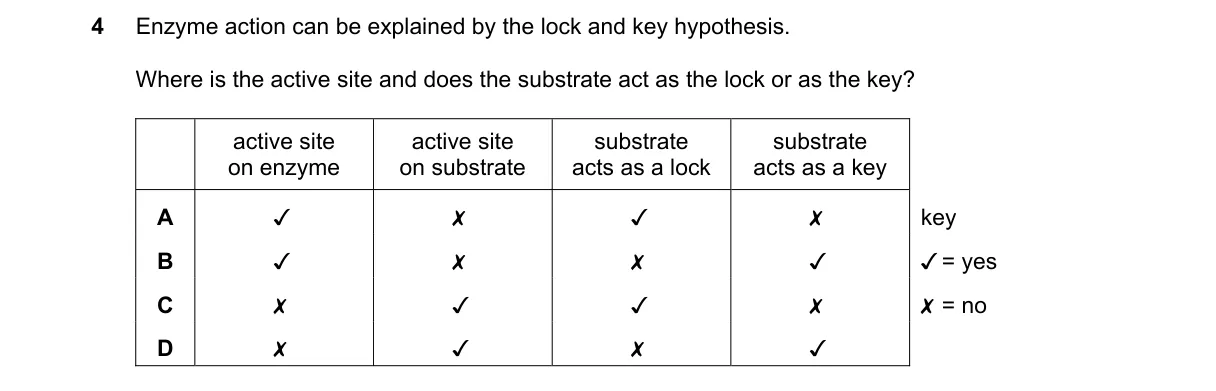
Answer choices
- Aactive site on enzyme (✓), active site on substrate (✗), substrate acts as lock (✗), substrate acts as key (✓)
- Bactive site on enzyme (✗), active site on substrate (✓), substrate acts as lock (✓), substrate acts as key (✗)
- Cactive site on enzyme (✗), active site on substrate (✓), substrate acts as lock (✗), substrate acts as key (✓)
- Dactive site on enzyme (✗), active site on substrate (✓), substrate acts as lock (✗), substrate acts as key (✓)
Explanation
Lock and Key Hypothesis for Enzyme Action
Steps:
- The lock and key hypothesis states that enzymes catalyze reactions by binding specific substrates at their active site.
- The active site is a region on the enzyme with a shape complementary to the substrate.
- In the analogy, the enzyme's active site acts as the lock, and the substrate acts as the key that fits perfectly.
- Match choices to this: active site on enzyme (true), on substrate (false), substrate as lock (false), as key (true).
Why A is correct:
- It accurately reflects the hypothesis definition, where the enzyme's active site is the lock and the substrate is the key.
Why the others are wrong:
- B: Falsely locates active site on substrate and calls substrate the lock, reversing the analogy.
- C: Incorrectly places active site on substrate while partially matching the key role.
- D: Same as C, wrongly attributes active site to substrate.
Final answer: A
Topic: Enzyme action
Practice more O Levels/IGCSE Biology (5090) questions on mMCQ.me