O Levels/IGCSE Biology (5090)•5090/11/O/N/18
O Levels/IGCSE Biology (5090) — 5090/11/O/N/18, Question 24
Which row shows the type of joint and type of movement permitted at a joint in the forelimb?
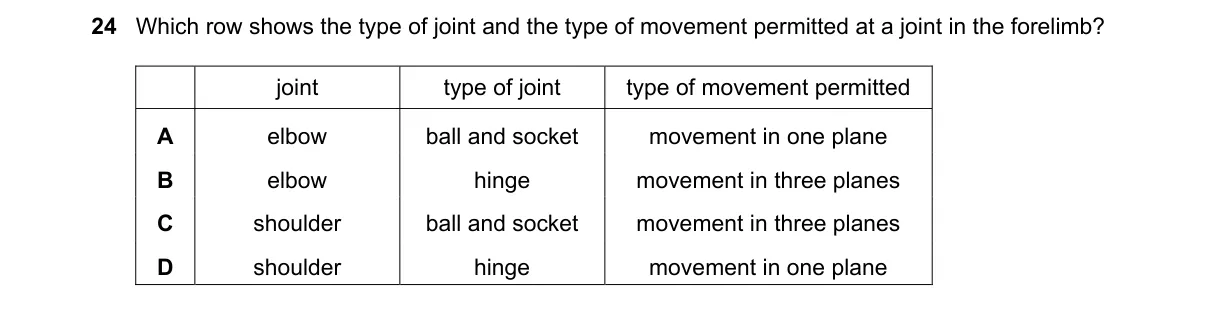
Answer choices
- Aelbow ball and socket movement in one plane
- Bshoulder ball hinge movement in three planes
- Cshoulder ball socket movement in three planes
- Dshoulder hinge movement in one plane
Explanation
Joint Types and Movements in Forelimb
Steps:
- Identify the shoulder joint as a ball-and-socket type, which connects the humerus to the scapula.
- Recognize that ball-and-socket joints permit multi-directional movement in three planes: sagittal, frontal, and transverse.
- Contrast with the elbow, a hinge joint allowing only flexion and extension in one plane.
- Match options to anatomical facts for the forelimb's shoulder.
Why C is correct:
- The shoulder is a ball-and-socket joint by definition, enabling rotation and movement in three planes due to the spherical head fitting into a cup-like socket.
Why the others are wrong:
- A: Elbow is a hinge, not ball-and-socket, and allows one-plane movement.
- B: Shoulder is ball-and-socket, not ball-hinge; hinge restricts to one plane.
- D: Shoulder is ball-and-socket, not hinge, and allows three-plane movement.
Final answer: C
Topic: Specialised cells, tissues and organs
Practice more O Levels/IGCSE Biology (5090) questions on mMCQ.me