O Levels/IGCSE Biology (5090)•5090/12/M/J/25
O Levels/IGCSE Biology (5090) — 5090/12/M/J/25, Question 36
Sickle cell anemia is caused by a recessive allele. A couple have two children. One of the children has sickle cell anemia. The other one does not have sickle cell anemia. The parents are expecting their third child. What is the probability that third child will be with sickle cell anemia?
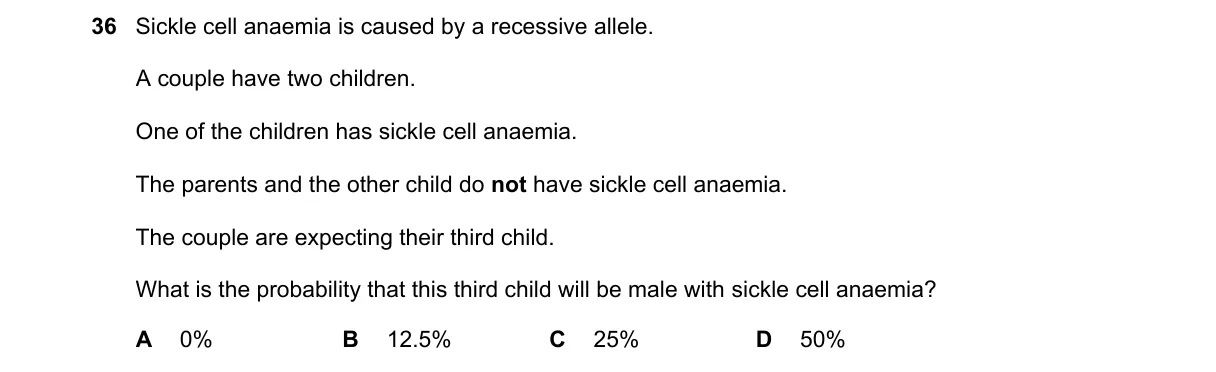
Answer choices
- A0%
- B12.5%
- C25%
- D50%
Explanation
Parental genotypes determine recessive trait probability Steps:
- Sickle cell anemia requires genotype aa; the affected child confirms both parents carry the a allele and are likely Aa (assuming parents unaffected).
- Unaffected child is AA or Aa, but this does not alter parental genotypes.
- For Aa × Aa cross, each child independently inherits a from mother (probability 1/2) and a from father (1/2).
- Thus, probability third child is aa = (1/2) × (1/2) = 1/4 = 25%.
Why C is correct:
- Punnett square for Aa × Aa shows aa offspring in 1/4 of cases, per Mendel's law of independent assortment.
Why the others are wrong:
- A: 0% ignores the established 1/4 chance from carrier parents.
- B: 12.5% misapplies probabilities, perhaps confusing with joint events, but each child is independent at 25%.
- D: 50% applies to Aa × aa cross, but data (unaffected parent implied) fits Aa × Aa better.
Final answer: C
Topic: Inheritance
Practice more O Levels/IGCSE Biology (5090) questions on mMCQ.me