O Levels/IGCSE Biology (5090)•5090/11/M/J/25
O Levels/IGCSE Biology (5090) — 5090/11/M/J/25, Question 7
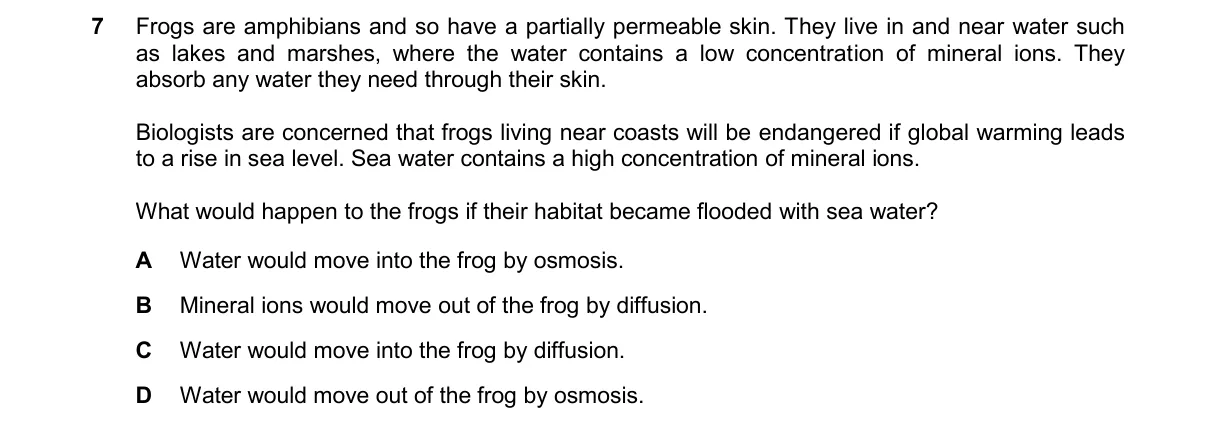
Frogs are amphibians and so have partially permeable skin. They live in lakes and marshes where the water contains a low concentration of mineral ions. They absorb any water they need through their skin. Biologists are concerned that frogs living near coasts will be endangered if global warming leads to a rise in sea level. What would happen to the frogs if their habitat became flooded with sea water?
Answer choices
- AWater would move into the frog by osmosis.
- BMineral ions would move out of the frog by diffusion.
- CMineral ions would move into the frog by diffusion.
- DWater would move out of the frog by osmosis.
Explanation
Osmosis in Hypertonic Saltwater
Steps:
- Frogs absorb water through permeable skin and maintain low internal ion concentration compared to freshwater.
- Sea water is hypertonic, with higher ion concentration outside the frog.
- Osmosis moves water from high to low concentration across the skin.
- Water exits the frog, causing dehydration.
Why D is correct:
- Osmosis is the net movement of water from a region of higher water potential (inside frog) to lower (sea water), defined by the concentration gradient.
Why the others are wrong:
- A: Incorrect; osmosis drives water out due to hypertonic external solution.
- B: Incorrect; ions diffuse into the frog down their concentration gradient, not out.
- C: Possible but not the primary threat; question focuses on water loss endangering frogs.
Final answer: D
Topic: Diffusion and osmosis
Practice more O Levels/IGCSE Biology (5090) questions on mMCQ.me