O Levels/IGCSE Biology (5090)•5090/11/M/J/25
O Levels/IGCSE Biology (5090) — 5090/11/M/J/25, Question 29
A nurse tests a sample of urine from a patient using Benedict's reagent. The sample tests positive. What is possible?
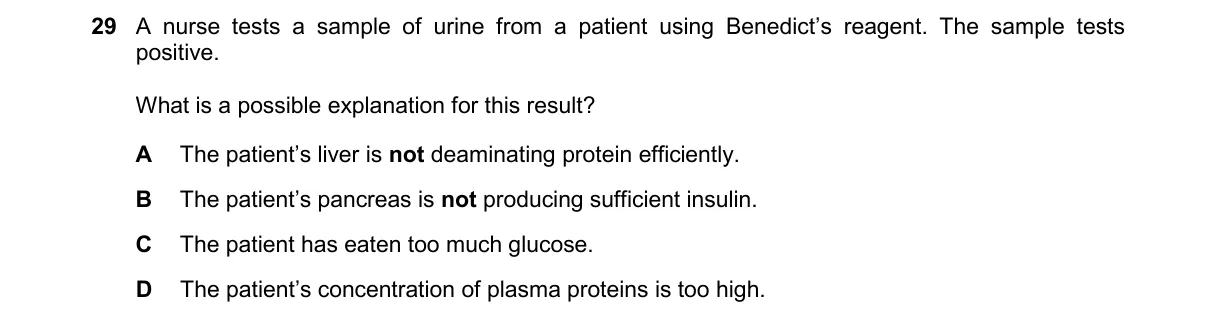
Answer choices
- AThe patient's liver is not deaminating protein.
- BThe patient's pancreas is not producing sufficient insulin.
- CThe patient has too much glucose.
- DThe patient's concentration of plasma is too high.
Explanation
Benedict's Test Indicates Glucosuria from Insulin Deficiency
Steps:
- Benedict's reagent detects reducing sugars, primarily glucose, in urine.
- A positive test confirms glucosuria, where glucose spills into urine.
- Glucosuria results from hyperglycemia exceeding the kidney's reabsorption threshold.
- Hyperglycemia often stems from insufficient insulin, impairing glucose uptake.
Why B is correct:
- Insufficient pancreatic insulin causes uncontrolled hyperglycemia, leading to glucosuria and a positive Benedict's test (definition: type 1 diabetes mellitus).
Why the others are wrong:
- A: Liver deamination processes amino acids into urea, unrelated to urine glucose detection.
- C: Excess glucose alone describes the symptom but ignores the insulin deficiency causing it.
- D: High plasma concentration typically refers to electrolytes or proteins, not sugars tested by Benedict's.
Final answer: B
Topic: Blood glucose control
Practice more O Levels/IGCSE Biology (5090) questions on mMCQ.me