O Levels/IGCSE Biology (5090)•5090/12/M/J/24
O Levels/IGCSE Biology (5090) — 5090/12/M/J/24, Question 2
Some young plants put into soil grew well for few weeks. They then began to show signs of disease. Samples of the diseased leaves were examined using a microscope. Which observations of the organism causing the disease show that it could be a fungus?
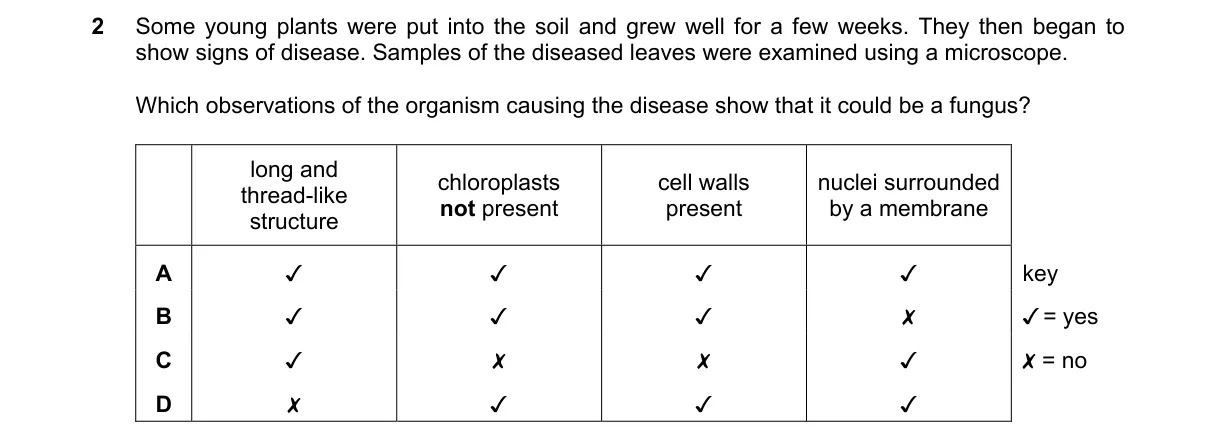
Answer choices
- Along-and thread-like structure: yes; chloroplasts present: no; cell walls: yes; nucleus surrounded by membrane: yes
- Blong-and thread-like structure: yes; chloroplasts present: no; cell walls: no; nucleus surrounded by membrane: yes
- Clong-and thread-like structure: no; chloroplasts present: yes; cell walls: no; nucleus surrounded by membrane: yes
- Dlong-and thread-like structure: no; chloroplasts present: yes; cell walls: yes; nucleus surrounded by membrane: yes
Explanation
Fungal traits in plant pathogens
Steps:
- Recall fungi are eukaryotic (membrane-bound nucleus), have chitin cell walls, form thread-like hyphae, and lack chloroplasts as they are non-photosynthetic.
- Evaluate options for hyphae (long thread-like structures), absence of chloroplasts, presence of cell walls, and eukaryotic nucleus.
- Match observations to fungal characteristics, eliminating those with plant-like or bacterial traits.
- Select the option aligning all key fungal features.
Why A is correct:
- Fungi exhibit hyphae (thread-like), chitin-based cell walls, eukaryotic nuclei, and no chloroplasts, per standard biological classification of Fungi kingdom.
Why the others are wrong:
- B lacks cell walls, unlike fungi which have chitin walls.
- C has chloroplasts and no hyphae, indicating photosynthetic algae or plants.
- D has chloroplasts and no hyphae, matching plant cells.
Final answer: A
Topic: Features of organisms
Practice more O Levels/IGCSE Biology (5090) questions on mMCQ.me