O Levels/IGCSE Biology (5090)•5090/12/M/J/23
O Levels/IGCSE Biology (5090) — 5090/12/M/J/23, Question 4
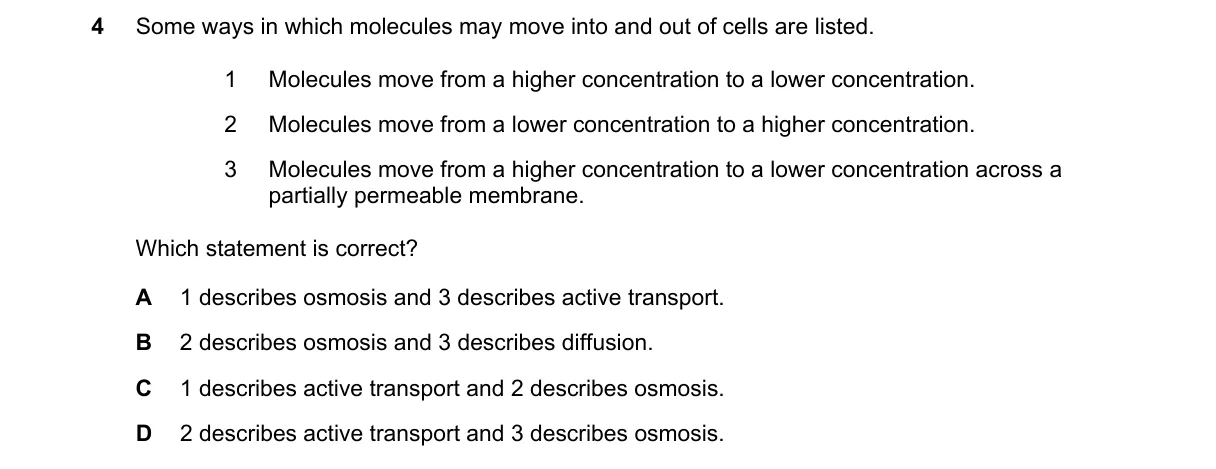
Some ways in which molecules may move in and out are listed. 1 Molecules move from a higher concentration to a lower concentration. 2 Molecules move from a lower concentration to a higher concentration. 3 Molecules move from a higher concentration to a lower concentration across a partially permeable membrane.
Answer choices
- A1 describes osmosis and 3 describes active transport.
- B1 describes osmosis and 3 describes diffusion.
- C2 describes active transport and 3 describes osmosis.
- D2 describes active transport and 3 describes osmosis.
Explanation
Matching Molecular Transport Processes
Steps:
- Description 1 indicates passive movement down a concentration gradient, typical of diffusion.
- Description 2 indicates movement against a concentration gradient, requiring energy, which defines active transport.
- Description 3 specifies passive movement down a gradient across a partially permeable membrane, characteristic of osmosis for water molecules.
- Compare options: only D correctly pairs 2 with active transport and 3 with osmosis.
Why D is correct:
- Active transport is defined as moving molecules from low to high concentration against the gradient, while osmosis is the net movement of water from high to low concentration across a partially permeable membrane.
Why the others are wrong:
- A: 1 describes general diffusion, not osmosis; 3 describes osmosis, not active transport.
- B: 1 describes diffusion, not osmosis; 3 is osmosis (water-specific), not general diffusion.
- C: 3 describes osmosis, not active transport.
Final answer: D
Topic: Diffusion and osmosis
Practice more O Levels/IGCSE Biology (5090) questions on mMCQ.me