O Levels/IGCSE Biology (5090)•5090/12/M/J/23
O Levels/IGCSE Biology (5090) — 5090/12/M/J/23, Question 22
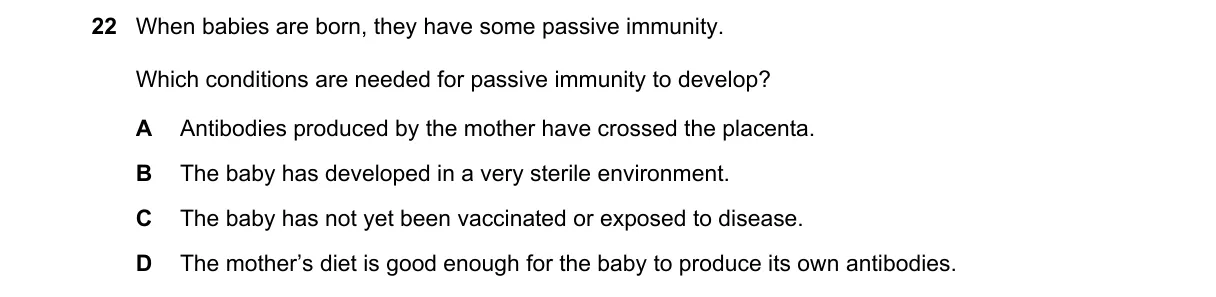
When babies are born, they have some passive immunity?
Answer choices
- AAntibodies produced by the mother have crossed the placenta.
- BThe baby has developed in a very sterile environment.
- CThe baby has not yet been vaccinated or exposed to disease.
- DThe mother’s diet is good enough for the baby to produce its own antibodies.
Explanation
Passive Immunity via Maternal Antibodies
Steps:
- Recall that passive immunity involves receiving pre-formed antibodies from another source, providing immediate but temporary protection.
- Identify that newborns receive antibodies from the mother during pregnancy.
- Confirm this transfer occurs across the placenta, protecting the baby from infections early in life.
- Eliminate options unrelated to antibody transfer.
Why A is correct:
- Passive immunity in newborns is defined as the transfer of maternal IgG antibodies across the placenta, granting short-term protection against pathogens.
Why the others are wrong:
- B: A sterile environment prevents exposure but does not confer immunity through antibodies.
- C: Lack of vaccination or exposure means no active immunity develops, but passive immunity still exists from the mother.
- D: The baby's antibody production is immature at birth; maternal diet supports health but doesn't enable fetal antibody creation.
Final answer: A
Topic: Immunity
Practice more O Levels/IGCSE Biology (5090) questions on mMCQ.me